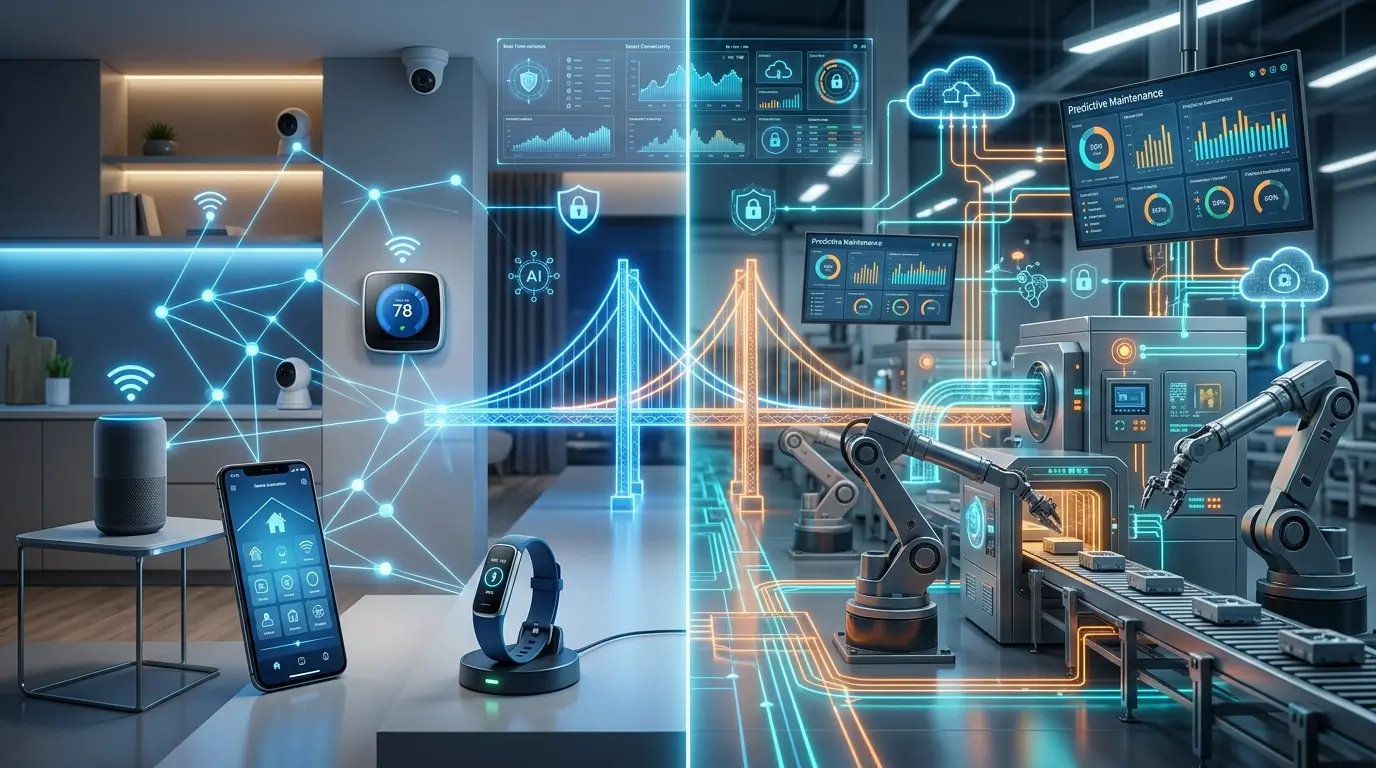
A few years ago, a family installed smart lights, a smart thermostat, and a voice assistant in their home. They could control everything from their phones. Around the same time, a manufacturing company installed thousands of connected sensors on factory machines to monitor performance and prevent breakdowns.
Both situations involved internet-connected devices, but they belonged to different technological categories: the Internet of Things (IoT) and the Industrial Internet of Things (IIoT).
Understanding the difference between IoT and IIoT is becoming increasingly important as connected technology expands across homes, businesses, and industries.
The difference between IoT and IIoT lies not only in where they are used but also in their goals, security requirements, and operational demands.
Learning the difference between IoT and IIoT helps students, technology enthusiasts, and professionals make informed decisions.
As industries embrace digital transformation, the difference between IoT and IIoT plays a major role in shaping innovation, efficiency, and productivity across society.
Key Difference Between IoT and IIoT
The primary difference is that IoT is designed mainly for consumer and everyday applications, while IIoT is developed for industrial environments where reliability, safety, and efficiency are critical.
IoT focuses on convenience and user experience. IIoT focuses on operational performance, productivity, and business outcomes.
Why Is Their Difference Necessary to Know for Learners and Experts?
Knowing the difference between IoT and IIoT helps learners understand how connected technologies are transforming modern life. It also helps experts choose the right solutions for specific environments.
For society, these technologies improve convenience, increase efficiency, reduce waste, enhance safety, and support innovation.
Smart homes, smart cities, healthcare systems, transportation networks, and manufacturing plants all benefit from connected devices.
Understanding their differences allows organizations to implement the most suitable technology for their needs.
Pronunciation
IoT
US Pronunciation: /ˌaɪ.oʊˈtiː/
UK Pronunciation: /ˌaɪ.əʊˈtiː/
Pronounced as: Eye-Oh-Tee
IIoT
US Pronunciation: /ˌaɪ.aɪ.oʊˈtiː/
UK Pronunciation: /ˌaɪ.aɪ.əʊˈtiː/
Pronounced as: Eye-Eye-Oh-Tee
A Quick Transition
Although IoT and IIoT share the same foundation of connected devices and data exchange, they differ significantly in purpose, environment, and implementation. Let us examine these differences in detail.
Difference Between IoT and IIoT
1. Purpose
IoT: Designed to improve convenience and lifestyle.
Examples:
- Smart speakers
- Smart refrigerators
IIoT: Designed to improve industrial operations and productivity.
Examples:
- Predictive maintenance systems
- Industrial robotics
2. Environment
IoT: Used in homes, offices, and personal settings.
Examples:
- Smart lighting systems
- Wearable fitness trackers
IIoT: Used in factories, power plants, and warehouses.
Examples:
- Factory automation systems
- Power grid monitoring sensors
3. Security Requirements
IoT: Security is important but often focuses on protecting user privacy.
Examples:
- Securing smart cameras
- Protecting smart home networks
IIoT: Security is critical because failures can disrupt operations.
Examples:
- Industrial firewall systems
- Secure manufacturing networks
4. Reliability
IoT: Temporary disruptions may be inconvenient.
Examples:
- Smart TV connection failure
- Voice assistant outage
IIoT: Downtime can cause major financial losses.
Examples:
- Production line interruption
- Energy plant monitoring failure
5. Data Volume
IoT: Generates moderate amounts of personal data.
Examples:
- Fitness tracking data
- Home temperature records
IIoT: Generates massive operational datasets.
Examples:
- Machine performance metrics
- Industrial sensor readings
6. Response Time
IoT: Can tolerate slight delays.
Examples:
- Smart bulbs
- Home entertainment systems
IIoT: Often requires real-time responses.
Examples:
- Automated assembly lines
- Industrial safety systems
7. Scale
IoT: Usually serves individuals or families.
Examples:
- Connected homes
- Personal wearable devices
IIoT: Serves large organizations.
Examples:
- Manufacturing plants
- Transportation networks
8. Cost of Failure
IoT: Failures typically affect convenience.
Examples:
- Smart lock malfunction
- Smart thermostat issue
IIoT: Failures can affect safety and productivity.
Examples:
- Equipment damage
- Workplace accidents
9. Communication Protocols
IoT: Uses consumer-friendly communication standards.
Examples:
- Wi-Fi
- Bluetooth
IIoT: Uses industrial-grade communication protocols.
Examples:
- Modbus
- OPC UA
10. Main Objective
IoT: Enhance user experience.
Examples:
- Smart home automation
- Health monitoring wearables
IIoT: Increase operational efficiency.
Examples:
- Predictive maintenance
- Asset tracking systems
Nature and Behavior of IoT
IoT is consumer-oriented, flexible, and focused on convenience. Its devices are designed to improve daily activities, automate routine tasks, and provide better user experiences.
Nature and Behavior of IIoT
IIoT is industrial-oriented, highly reliable, and performance-driven. Its systems prioritize safety, efficiency, accuracy, and continuous operation.
Why Are People Confused About Their Use?
People often confuse IoT and IIoT because both involve connected devices, sensors, cloud computing, and data analytics. The technologies use similar principles, making them appear identical. However, their applications, priorities, and requirements are quite different.
Difference and Similarity Table
| Feature | IoT | IIoT |
| Full Form | Internet of Things | Industrial Internet of Things |
| Main Users | Consumers | Industries |
| Environment | Homes and offices | Factories and industrial sites |
| Goal | Convenience | Efficiency |
| Security Level | Moderate | Very High |
| Reliability | Important | Critical |
| Data Usage | Personal insights | Operational insights |
| Failure Impact | Inconvenience | Financial and safety risks |
| Scale | Individual users | Large organizations |
| Similarity | Both use connected devices, sensors, networks, and data analytics |
When IoT Is Better
IoT is the better choice when the goal is to improve convenience, comfort, and personal productivity.
Smart homes, wearable devices, connected appliances, and personal health monitoring systems are excellent examples.
Consumers benefit from easy installation, user-friendly interfaces, and affordable solutions. For everyday life, IoT offers practical advantages that make tasks simpler and more efficient.
When IIoT Is Better
IIoT is the better choice when organizations need reliability, efficiency, and operational intelligence. Manufacturing plants, transportation companies, energy providers, and healthcare institutions use IIoT to optimize processes and reduce downtime.
In environments where safety and productivity are essential, IIoT delivers greater value through advanced monitoring and predictive analytics.
How the Keywords Are Used in Metaphors and Similes
IoT Metaphors
- IoT is the digital nervous system of a smart home.
- IoT acts as the invisible bridge connecting daily devices.
IoT Similes
- The smart home worked like a well-trained assistant.
- Connected devices communicated like close friends.
IIoT Metaphors
- IIoT is the heartbeat of modern industry.
- IIoT serves as the brain of intelligent manufacturing.
IIoT Similes
- Industrial sensors worked like vigilant guards.
- Factory networks communicated like synchronized musicians.
Connotative Meaning
IoT
Positive: Innovation, convenience, comfort
Example:
- Smart homes symbolize modern convenience.
Negative: Privacy concerns, dependency on technology
Example:
- Some people worry about data collection.
Neutral: Connected technology
Example:
- IoT devices exchange information automatically.
IIoT
Positive: Efficiency, productivity, safety
Example:
- IIoT improves industrial performance.
Negative: High implementation costs
Example:
- Industrial upgrades may require significant investment.
Neutral: Industrial connectivity
Example:
- IIoT links machines and operational systems.
Idioms and Proverbs Related to the Concepts
Since there are no traditional idioms specifically for IoT or IIoT, related technology expressions can be used.
“A chain is only as strong as its weakest link”
Example:
- An IIoT network is only as secure as its weakest device.
“Knowledge is power”
Example:
- IoT generates data because knowledge is power in decision-making.
“Time is money”
Example:
- IIoT reduces downtime because time is money in manufacturing.
Works in Literature Related to the Topics
IoT-Related Works
- The Internet of Things — Samuel Greengard (Technology, 2015)
- Designing the Internet of Things — Adrian McEwen (Technology, 2013)
- Building the Internet of Things — Maciej Kranz (Technology, 2016)
IIoT-Related Works
- Industrial Internet — Jon Bruner (Technology, 2013)
- Industrial Internet of Things — Alasdair Gilchrist (Technology, 2016)
- The Digital Factory — Various Authors (Industry, 2018)
Movies Related to Technology and Connected Systems
- The Matrix (1999, USA)
- I, Robot (2004, USA)
- Transcendence (2014, USA)
- Her (2013, USA)
- Upgrade (2018, Australia)
Frequently Asked Questions
1. What does IoT stand for?
IoT stands for Internet of Things, a network of connected consumer devices.
2. What does IIoT stand for?
IIoT stands for Industrial Internet of Things, a network of connected industrial devices and systems.
3. Is IIoT a part of IoT?
Yes. IIoT is considered a specialized branch of IoT focused on industrial applications.
4. Which is more secure, IoT or IIoT?
IIoT generally requires stronger security because industrial operations involve greater risks.
5. Can IoT and IIoT work together?
Yes. Many organizations integrate consumer and industrial systems to create connected ecosystems.
How Both Are Useful for Surroundings
IoT improves daily life by making homes smarter, reducing energy consumption, and supporting health monitoring
. IIoT benefits society by improving manufacturing efficiency, reducing waste, enhancing workplace safety, and strengthening infrastructure. Together, they contribute to sustainable development, innovation, and economic growth.
Final Words for Both
IoT and IIoT represent two important branches of connected technology. While IoT focuses on personal convenience and smart living, IIoT focuses on industrial performance and operational excellence.
Both technologies continue to shape the future by connecting devices, collecting data, and enabling intelligent decision-making.
Conclusion
The difference between IoT and IIoT extends beyond their names. Although both rely on connected devices, sensors, and data analytics, their objectives are distinct.
IoT aims to improve everyday life through convenience and automation, while IIoT enhances industrial efficiency, reliability, and safety.
Understanding these differences helps learners, professionals, and organizations choose the right technology for specific needs.
As the world becomes increasingly connected, both IoT and IIoT will continue to drive innovation across homes, cities, businesses, and industries.
Their combined impact is creating a smarter, more efficient, and more connected future for everyone.

Daniel Carter is a research writer and comparison specialist at Compadiff. He focuses on breaking down complex topics into simple explanations so readers can clearly understand the differences between similar concepts, products, and ideas.