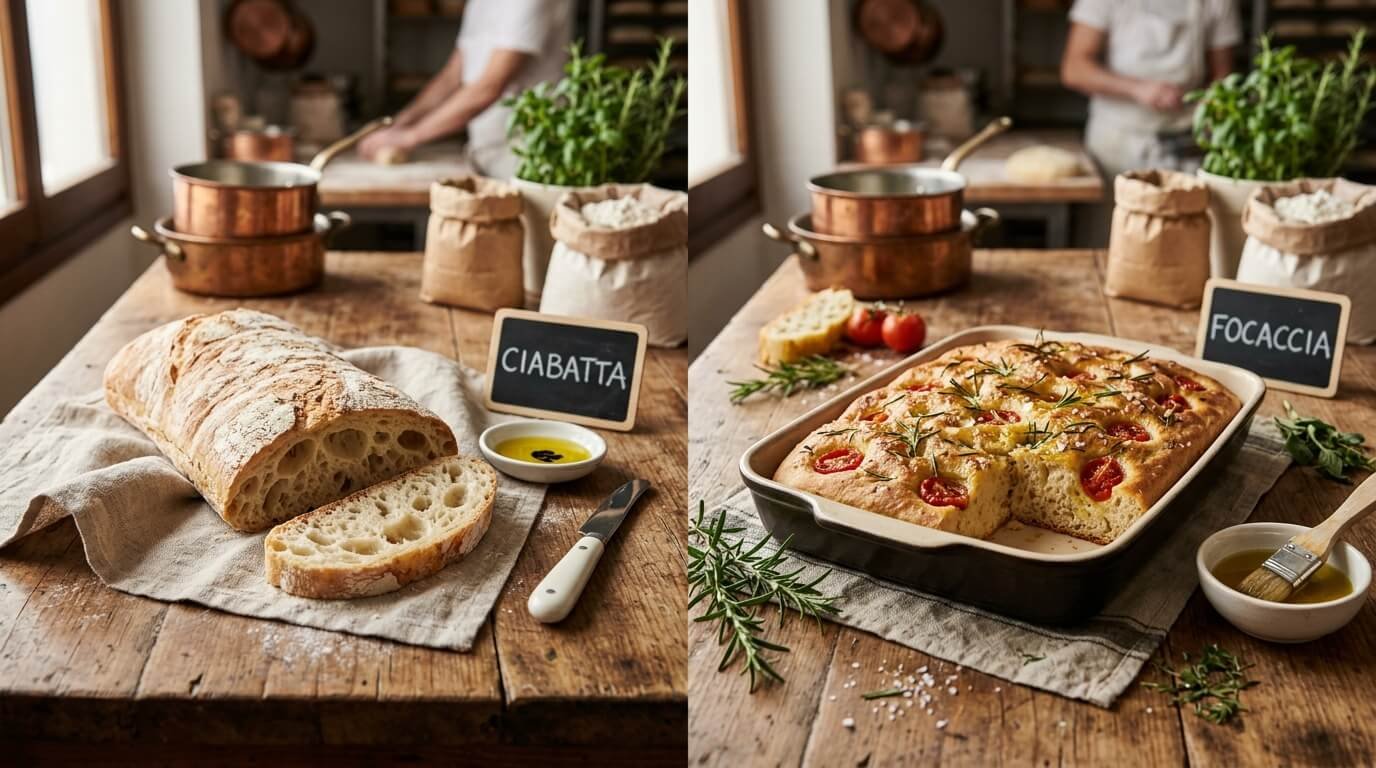
Imagine walking into a traditional Italian bakery on a quiet morning. The aroma of freshly baked bread fills the air, and two golden loaves immediately catch your attention. One has a rustic, elongated shape with a crisp crust and airy interior. Meanwhile, the other is flat, soft, and decorated with fragrant herbs and olive oil. Many first-time visitors assume they are simply different shapes of the same bread. However, the baker smiles and explains that one is ciabatta while the other is focaccia, each with its own history, ingredients, texture, and purpose.
Although both breads originated in Italy and share simple ingredients such as flour, water, yeast, olive oil, and salt, they are far from identical. Furthermore, the difference between ciabatta and focaccia becomes clear when you compare their texture, appearance, baking techniques, and serving styles. While ciabatta is famous for its chewy crumb and crispy crust, focaccia is known for its soft texture, rich olive oil flavor, and dimpled surface. In addition, knowing this difference helps you choose the right bread for every meal.
Why Is It Important to Know the Difference Between Ciabatta and Focaccia?
Understanding the differences between ciabatta and focaccia benefits both beginners and experienced professionals.
For learners, it builds confidence in recognizing authentic Italian breads and improves baking skills. Students of culinary arts gain a clearer understanding of dough hydration, fermentation, and baking techniques.
For chefs and bakers, selecting the appropriate bread improves menu planning and customer satisfaction. Restaurants often choose ciabatta for gourmet sandwiches because of its sturdy crust, while focaccia is preferred as a table bread, appetizer, or pizza style base.
For consumers, knowing the difference helps them make better purchasing decisions based on taste preferences, meal type, and nutritional considerations.
In society, traditional breads such as ciabatta and focaccia preserve cultural heritage while inspiring modern recipes across different cuisines. Understanding their unique identities encourages appreciation for authentic baking traditions and supports informed food choices.
Pronunciation
Ciabatta
| Accent | Pronunciation |
| US | chee uh BAH tuh |
| UK | chuh BAH tuh |
Focaccia
| Accent | Pronunciation |
| US | foh KAH chuh |
| UK | foh KATCH uh |
A Linking Hook to the Main Discussion
Now that you understand what makes these two famous Italian breads unique and why their differences matter, it is time to explore them in greater depth. In the following section, we will compare ciabatta and focaccia across ten major aspects.
Specifically, these include ingredients, texture, crust, baking method, flavor, nutritional value, serving style, and ideal culinary uses. Furthermore, each point comes with practical examples that make every difference easy to understand. As a result, by the end of this comparison, you will have a complete and clear picture of both breads.
Difference Between Ciabatta and Focaccia
Although ciabatta and focaccia are both beloved Italian breads, they are created with different purposes in mind.
Ciabatta is crafted to achieve a light, airy crumb with a crispy crust, while focaccia is designed to be soft, flavorful, and rich with olive oil. Below are ten important points that clearly explain their differences.
1. Difference in Shape
Ciabatta
Ciabatta has a long, rectangular, or slipper like shape. In fact, its name means “slipper” in Italian because of its appearance. Bakers usually leave the dough rustic without trying to create a perfect form.
Examples
- A bakery serves ciabatta as a long sandwich loaf.
- Homemade ciabatta often has uneven edges, giving it an artisan look.
Focaccia
Focaccia is flat and wide. It is baked in a pan, allowing it to spread evenly across the surface.
Examples
- A family cuts a large sheet of focaccia into square pieces for dinner.
- Restaurants often serve focaccia as a flat appetizer before the main course.
2. Difference in Texture
Ciabatta
Ciabatta has a crispy crust and an open, airy interior with many large holes. The inside remains chewy while the outside stays crunchy.
Examples
- Toasted ciabatta creates a satisfying crunch.
- A ciabatta sandwich holds fillings without becoming too soft.
Focaccia
Focaccia is soft, fluffy, and tender. Olive oil keeps the bread moist even after baking.
Examples
- Warm focaccia feels soft when pressed.
- Fresh focaccia remains fluffy the next day.
3. Difference in Dough Hydration
Ciabatta
Ciabatta uses a very wet dough. The high water content creates the famous air pockets inside the bread.
Examples
- Bakers use extra flour to handle sticky ciabatta dough.
- Long fermentation improves its open crumb.
Focaccia
Focaccia also contains moisture but includes more olive oil, making the dough smoother and richer.
Examples
- Olive oil prevents focaccia dough from sticking to the pan.
- The dough is stretched gently instead of shaped into a loaf.
4. Difference in Crust
Ciabatta
Its crust is thin, crisp, and slightly chewy after baking.
Examples
- Ciabatta produces a crunchy sound when sliced.
- Toasting makes the crust even crispier.
Focaccia
The crust is golden, lightly crisp, and coated with olive oil, giving it a rich flavor.
Examples
- Fresh rosemary focaccia has a delicate crispy top.
- Olive oil keeps the crust soft underneath.
5. Difference in Flavor
Ciabatta
Ciabatta has a mild wheat flavor that pairs well with many foods without overpowering them.
Examples
- Ciabatta complements grilled chicken sandwiches.
- It tastes delicious with butter and soup.
Focaccia
Focaccia, on the other hand, has a richer and more complex flavor, mainly because of its generous use of olive oil. In addition, common toppings such as herbs, garlic, onions, olives, and tomatoes make its taste even more bold and satisfying.
Examples
- Garlic focaccia has a bold aroma.
- Rosemary and sea salt create a savory taste.
6. Difference in Baking Method
Ciabatta
Ciabatta is usually baked directly on a baking stone or baking tray to develop a crisp crust.
Examples
- Steam inside the oven helps create a crunchy exterior.
- Professional bakeries often bake ciabatta on stone decks.
Focaccia
Focaccia is baked in a generously oiled pan, allowing the bread to develop a soft texture with a golden base.
Examples
- Bakers drizzle olive oil before and after baking.
- Finger dimples help the oil spread evenly.
7. Difference in Ingredients
Ciabatta
Ciabatta relies mainly on flour, water, yeast, salt, and a small amount of olive oil.
Examples
- Traditional ciabatta recipes contain very few ingredients.
- Bakers focus on fermentation rather than toppings.
Focaccia
Focaccia contains similar ingredients but uses much more olive oil and frequently includes herbs, vegetables, cheese, or spices.
Examples
- Cherry tomatoes are baked into focaccia.
- Black olives add extra flavor.
8. Difference in Common Uses
Ciabatta
Ciabatta is mainly used for sandwiches, paninis, garlic bread, and toast.
Examples
- A café serves grilled vegetable paninis on ciabatta.
- Breakfast toast is often made from ciabatta slices.
Focaccia
Focaccia is commonly served as an appetizer, snack, side dish, or pizza style bread.
Examples
- Restaurants offer focaccia before the main meal.
- Focaccia is served alongside pasta and salads.
9. Difference in Appearance
Ciabatta
The surface looks rustic, flour dusted, and irregular.
Examples
- Fresh ciabatta has a lightly cracked crust.
- Each loaf looks slightly different.
Focaccia
Its surface has distinctive finger made dimples filled with olive oil and toppings.
Examples
- Herbs decorate the top beautifully.
- Tomatoes and onions make the bread colorful.
10. Difference in Best Serving Occasions
Ciabatta
Ciabatta is ideal for meals that require sturdy bread capable of holding fillings.
Examples
- Picnic sandwiches stay intact on ciabatta.
- Gourmet burgers use ciabatta rolls.
Focaccia
Focaccia is perfect for gatherings, parties, and family dinners where bread is shared.
Examples
- Guests enjoy warm focaccia before dinner.
- Focaccia is served on appetizer platters during celebrations.
Nature and Characteristics of Ciabatta
Ciabatta is rustic, chewy, airy, and versatile. It is intentionally simple in appearance but highly valued for its crispy crust and open crumb.
Its neutral flavor makes it suitable for both savory and mildly sweet accompaniments. Ciabatta is durable enough to hold heavy fillings without falling apart, making it one of the world’s favorite sandwich breads.
Nature and Characteristics of Focaccia
Focaccia is soft, rich, aromatic, and comforting. It absorbs olive oil beautifully and welcomes a variety of toppings, making every loaf unique.
Its fluffy interior and flavorful crust make it enjoyable on its own or alongside soups, salads, roasted meats, and pasta dishes. Focaccia is often associated with sharing, hospitality, and festive meals.
Why Are People Confused About Their Use?
Many people confuse ciabatta and focaccia because both are traditional Italian breads made with flour, yeast, water, salt, and olive oil. They are frequently displayed together in bakeries and supermarkets, leading customers to believe they are simply different shapes of the same bread.
The confusion also arises because both breads can be served with sandwiches, soups, salads, and Mediterranean meals.
However, their baking methods, textures, flavors, and culinary purposes are quite different. Ciabatta is primarily chosen for its crispy structure and sandwich making ability, while focaccia is appreciated for its soft texture, olive oil richness, and flavorful toppings.
Understanding these distinctions helps both home cooks and professional chefs select the perfect bread for every recipe and occasion.
Here’s Part 3, completing your SEO friendly article.
Difference and Similarity Between Ciabatta and Focaccia
| Feature | Ciabatta | Focaccia | Similarity |
| Origin | Italy | Italy | Both originated in Italy. |
| Shape | Long, rectangular loaf | Flat, pan baked bread | Both are artisan breads. |
| Texture | Chewy with large air holes | Soft and fluffy | Both have light interiors. |
| Crust | Crispy and thin | Soft with a lightly crisp top | Both develop golden crusts during baking. |
| Dough | Very high hydration | Hydrated with more olive oil | Both use yeast based dough. |
| Flavor | Mild and slightly nutty | Rich and savory | Both pair well with many dishes. |
| Toppings | Usually plain | Herbs, garlic, olives, tomatoes, cheese | Both can be customized. |
| Main Use | Sandwiches and toast | Appetizers, side dishes, snacks | Both are served with meals. |
| Baking Method | Baked on a stone or tray | Baked in an oiled pan | Both are oven baked. |
| Popularity | Excellent for sandwiches | Excellent for sharing | Both are enjoyed worldwide. |
When Is Ciabatta the Better Choice?
Ciabatta is the better option when you need bread that is sturdy enough to hold fillings. Its crispy crust and chewy interior make it perfect for sandwiches, paninis, burgers, garlic bread, and toasted snacks.
If you enjoy a rustic bread with a light, airy crumb and a satisfying crunch, ciabatta is an excellent choice. It also pairs wonderfully with soups, salads, and grilled meats because it absorbs sauces without becoming soggy too quickly.
When Is Focaccia the Better Choice?
Focaccia is ideal when you want a soft, flavorful bread that can be enjoyed on its own or shared with family and friends. It works perfectly as an appetizer, party snack, side dish, or accompaniment to pasta, soups, and salads.
Because it is enriched with olive oil and often topped with herbs or vegetables, focaccia delivers a richer taste and requires fewer additional ingredients to be delicious.
How the Words Are Used in Metaphors and Similes
Although these bread names are not common in traditional English figurative language, they are increasingly used in food writing and everyday conversation.
Ciabatta
Metaphors
- “His ideas were like ciabatta—simple on the outside but full of depth inside.”
- “The project became the ciabatta of the bakery, reliable and loved by everyone.”
Similes
- “The sandwich was as sturdy as ciabatta.”
- “Her homemade loaf was as airy as fresh ciabatta.”
Focaccia
Metaphors
- “The celebration was a focaccia of flavors and happiness.”
- “Her kindness was focaccia—warm, comforting, and shared with everyone.”
Similes
- “The bread was as soft as fresh focaccia.”
- “The aroma spread through the house like warm focaccia from the oven.”
Connotative Meaning
Ciabatta
Positive
- Artisan craftsmanship
- Freshness
- Simplicity
- Rustic quality
Example: “The café became famous for its authentic ciabatta sandwiches.”
Negative
Very few negative meanings exist, though it may suggest plainness compared to heavily flavored breads.
Example: “Some people find plain ciabatta less exciting than topped breads.”
Neutral
Simply refers to a traditional Italian bread.
Example: “The bakery sells ciabatta every morning.”
Focaccia
Positive
- Hospitality
- Comfort
- Celebration
- Rich flavor
Example: “Fresh focaccia welcomed every guest at the dinner table.”
Negative
Sometimes associated with being richer in oil and calories.
Example: “People on strict diets may eat focaccia in moderation.”
Neutral
Refers to a flat Italian bread.
Example: “The restaurant serves focaccia before every meal.”
Idioms or Proverbs Related to the Words
There are no widely recognized English idioms or proverbs specifically containing the words ciabatta or focaccia. However, these bread related expressions are appropriate.
“Breaking bread”
Meaning: Sharing friendship or a meal.
Example: “The neighbors broke bread together with fresh focaccia.”
“The best thing since sliced bread”
Meaning: Something very useful or impressive.
Example: “Many chefs say ciabatta is the best thing since sliced bread for gourmet sandwiches.”
“Bread is the staff of life”
Meaning: Bread is an essential food.
Example: “Both ciabatta and focaccia remind us that bread is the staff of life.”
Works in Literature
While there are very few famous literary works solely dedicated to either bread, both appear in culinary literature.
Ciabatta
- The Italian Baker – Bread & Baking – Carol Field – 1985
- Bread: A Baker’s Book of Techniques and Recipes – Baking – Jeffrey Hamelman – 2004
- Flour Water Salt Yeast – Baking – Ken Forkish – 2012
Focaccia
- The Italian Baker – Bread & Baking – Carol Field – 1985
- The Bread Baker’s Apprentice – Baking – Peter Reinhart – 2001
- Tartine Bread – Baking – Chad Robertson – 2010
Movies Related to the Keywords
There are no major internationally recognized feature films specifically titled Ciabatta or Focaccia.
However, these food documentaries feature artisan bread making, including Italian breads.
- Cooked (2016, USA) – Documentary Series
- Salt Fat Acid Heat (2018, USA) – Documentary Series
- Chef’s Table: Pizza (2022, USA) – Documentary Series
Frequently Asked Questions
1. What is the biggest difference between ciabatta and focaccia?
Ciabatta is a crusty loaf with an airy interior, while focaccia is a soft, flat bread enriched with olive oil and toppings.
2. Which bread is better for sandwiches?
Ciabatta is generally the better choice because its firm crust and chewy texture hold fillings well.
3. Is focaccia healthier than ciabatta?
Neither is universally healthier. Focaccia usually contains more olive oil, while ciabatta often has fewer added fats.
4. Can ciabatta and focaccia be used interchangeably?
Sometimes, but the results differ. Ciabatta is better for sandwiches, while focaccia is ideal as a side dish or appetizer.
5. Are both breads Italian?
Yes. Both are traditional Italian breads that have become popular around the world.
How Both Are Useful for Our Surroundings
Ciabatta and focaccia contribute to communities by supporting local bakeries, restaurants, and food businesses. Their production creates employment for farmers, millers, bakers, transport workers, and retailers.
Homemade versions encourage families to cook together and reduce reliance on highly processed foods. When prepared with locally sourced ingredients, these breads also promote sustainable agriculture and strengthen regional food traditions.
Their popularity helps preserve Italy’s rich baking heritage while inspiring people around the world to appreciate artisan craftsmanship.
Final Words for Both
Ciabatta and focaccia represent two different expressions of Italian baking excellence. Ciabatta impresses with its crisp crust, airy crumb, and versatility for sandwiches, while focaccia delights with its soft texture, aromatic olive oil, and flavorful toppings.
Neither bread is superior in every situation; each shines when used for the purpose it was designed for. Understanding their differences allows you to make better culinary choices and enjoy authentic Italian flavors.
Conclusion
Although ciabatta and focaccia share Italian roots and several basic ingredients, they offer distinct experiences in texture, flavor, appearance, and culinary use. Ciabatta is prized for its rustic loaf, crisp crust, and airy interior, making it ideal for sandwiches and toasted dishes.
Focaccia, enriched with olive oil and often decorated with herbs or vegetables, is cherished for its soft texture and rich flavor, making it perfect for appetizers, side dishes, and family gatherings. Learning the difference between these two classic breads helps home cooks, culinary students, and professional chefs choose the right bread for every occasion.
Whether you prefer the crisp bite of ciabatta or the comforting softness of focaccia, both breads celebrate the tradition, creativity, and timeless appeal of Italian baking.

Sophia Bennett is a content researcher and editor at Compadiff, where she specializes in creating clear and engaging comparison articles. Her work focuses on explaining differences in health, lifestyle, education, and everyday topics in a way that is easy for readers to understand.