Many people see a bagel and a bialy and assume they are the same type of bread. At first glance, they look similar because both are round, chewy baked goods with roots in Eastern European Jewish communities.
However, despite their resemblance, bagels and bialys have significant differences in preparation, texture, flavor, and appearance.
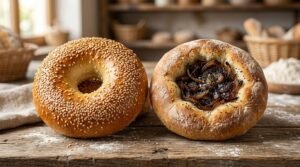
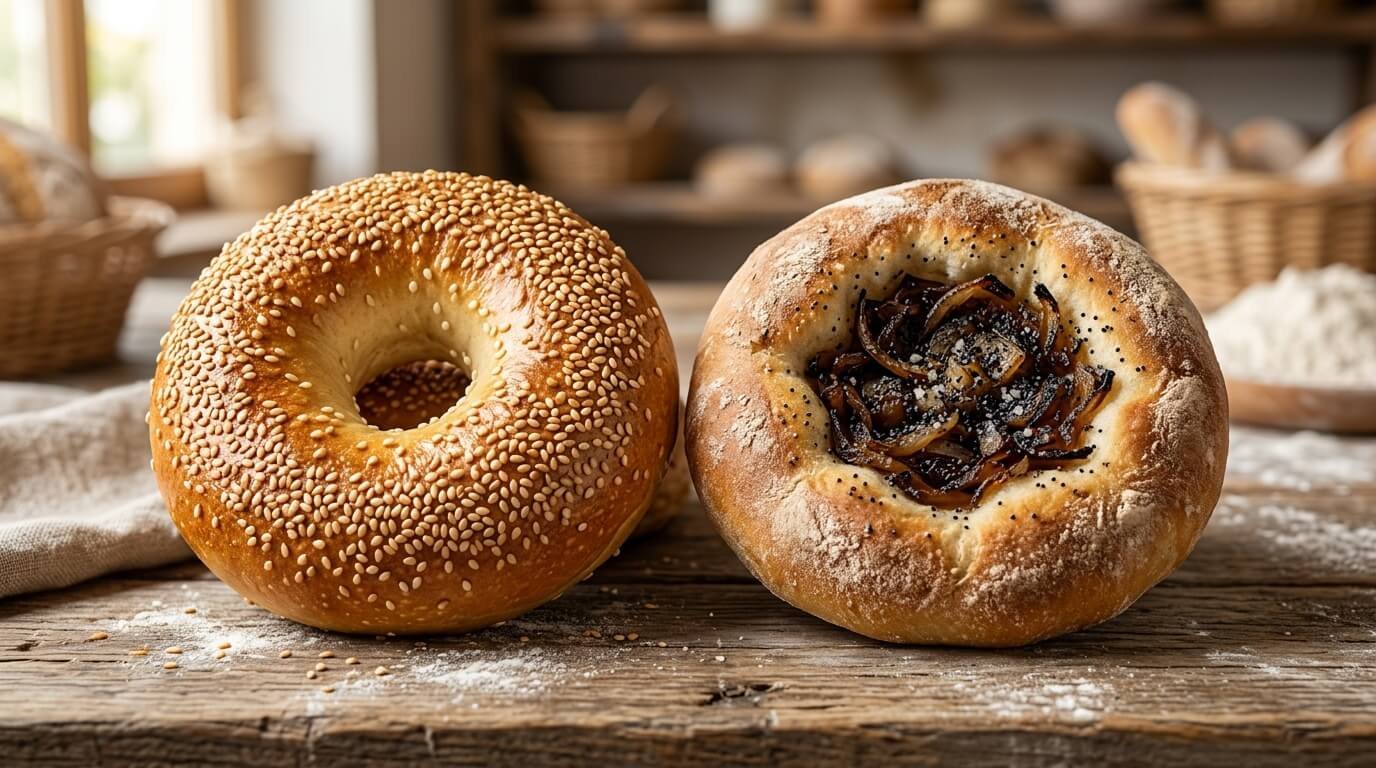
Imagine walking into a bakery and seeing two round breads side by side. One has a hole in the center and a shiny crust, while the other has a small depression filled with onions.
Understanding the difference between a bagel and a bialy helps food lovers appreciate their unique histories and choose the one that best suits their taste.
In this guide, we will explore everything you need to know about bagels and bialys, from their origins to their ingredients, cooking methods, nutritional value, and ideal uses.
What Is a Bagel?
A bagel is a round bread roll with a hole in the center. It is traditionally made from wheat flour dough that is first boiled and then baked.
The boiling process gives bagels their distinctive chewy texture and glossy crust.
Bagels are commonly topped with sesame seeds, poppy seeds, garlic, onion flakes, or everything seasoning.
Key Characteristics of a Bagel
- Ring-shaped with a hole in the center
- Boiled before baking
- Dense and chewy texture
- Crisp outer crust
- Available in many flavors and toppings
What Is a Bialy?
A bialy is a traditional yeast roll originating from Białystok, Poland. Unlike a bagel, a bialy does not have a hole in the center.
Instead, it has a shallow indentation often filled with onions, garlic, breadcrumbs, or poppy seeds.
Bialys are baked directly without being boiled, resulting in a softer and lighter texture.
Key Characteristics of a Bialy
- Round shape with a center depression
- Baked without boiling
- Soft and airy texture
- Usually filled with onions
- Less chewy than a bagel
Difference Between Bagel and Bialy
Quick Comparison Table
| Feature | Bagel | Bialy |
| Shape | Ring with a hole | Round with a center indentation |
| Cooking Method | Boiled then baked | Only baked |
| Texture | Dense and chewy | Soft and light |
| Crust | Glossy and firm | Softer crust |
| Filling | Usually toppings only | Often filled with onions |
| Origin | Jewish communities in Poland | Białystok, Poland |
| Flavor | Slightly sweet and chewy | Savory and bread-like |
Origin and History
History of Bagels
Bagels originated in Jewish communities of Poland several centuries ago. They became popular because they were portable, filling, and easy to store. Jewish immigrants later brought bagels to North America, where they became a breakfast staple.
History of Bialys
Bialys originated in Białystok, a city in northeastern Poland. Jewish bakers created them as a simple bread with a flavorful onion-filled center. Although less famous than bagels, bialys remain popular among traditional bakeries.
Preparation Process
How Bagels Are Made
The process of making bagels involves:
- Mixing flour, water, yeast, and salt
- Shaping dough into rings
- Allowing the dough to rise
- Boiling the dough briefly
- Adding toppings
- Baking until golden brown
The boiling stage is what creates the bagel’s unique texture.
How Bialys Are Made
Making bialys generally includes:
- Preparing yeast dough
- Forming round rolls
- Creating a center depression
- Adding onion filling
- Baking directly in the oven
Since there is no boiling step, bialys remain softer.
Texture Differences
One of the most noticeable differences between bagels and bialys is texture.
Bagel Texture
Bagels are:
- Dense
- Chewy
- Firm
- Slightly elastic
This texture comes from boiling the dough before baking.
Bialy Texture
Bialys are:
- Softer
- Lighter
- More bread-like
- Easier to bite into
Their texture resembles a dinner roll more than a bagel.
Taste Differences
Bagel Flavor
Bagels often have:
- Mild sweetness
- Toasted flavor
- Rich chewy bite
Popular flavors include plain, cinnamon raisin, blueberry, sesame, and everything bagels.
Bialy Flavor
Bialys typically feature:
- Savory taste
- Onion flavor
- Mild bread aroma
Their onion-filled center gives them a unique taste profile.
Nutritional Comparison
Both bagels and bialys provide carbohydrates and energy, but bagels are often larger and contain more calories.
Bagel Nutrition
- Higher calories
- More carbohydrates
- Denser serving size
Bialy Nutrition
- Slightly fewer calories
- Lighter texture
- Smaller serving size
Exact nutritional values depend on ingredients and bakery recipes.
Popular Ways to Eat Bagels
Bagels are commonly served with:
- Cream cheese
- Butter
- Smoked salmon
- Eggs
- Peanut butter
- Avocado
They are frequently enjoyed as breakfast or brunch items.
Popular Ways to Eat Bialys
Bialys are often eaten:
- Warm from the oven
- With butter
- Alongside soups
- As a snack
- With savory spreads
The onion center makes them especially appealing for savory meals.
Which One Is Better?
Neither is objectively better. The choice depends on personal preference.
Choose a bagel if you enjoy:
- Chewy texture
- Hearty bread
- Variety of toppings
Choose a bialy if you prefer:
- Softer bread
- Onion flavor
- Lighter texture
Many people enjoy both for different occasions.
Common Misconceptions
“Bialys Are Just Bagels Without Holes”
This is incorrect. The major difference is not just the hole. The preparation method, texture, flavor, and history are all different.
“Bagels and Bialys Taste the Same”
Although both are bread products, their flavor profiles are quite distinct due to their cooking methods and toppings.
Conclusion
The difference between bagel and bialy goes far beyond appearance. Bagels are boiled before baking, creating a dense and chewy texture with a signature hole in the center.
Bialys are baked without boiling and feature a soft texture with a savory onion-filled indentation. Both have rich cultural histories and unique flavors that make them beloved bakery favorites.
Whether you prefer the chewiness of a bagel or the softness of a bialy, understanding these differences helps you appreciate each bread’s special place in culinary tradition.

Sophia Bennett is a content researcher and editor at Compadiff, where she specializes in creating clear and engaging comparison articles. Her work focuses on explaining differences in health, lifestyle, education, and everyday topics in a way that is easy for readers to understand.