Have you ever seen a small furry animal running through your garden and wondered whether it was a chipmunk or a squirrel? Many people confuse these two animals because they belong to the same family and share several physical characteristics.
However, there are many important distinctions that make each species unique. Understanding the difference between chipmunks and squirrels is useful for students, wildlife enthusiasts, gardeners, and anyone interested in nature.
Chipmunks and squirrels are common in forests, parks, and residential areas. They both collect food, climb, and play important roles in maintaining healthy ecosystems.
Yet their appearance, behavior, habitat, and survival strategies differ significantly. Learning the difference between chipmunks and squirrels helps people identify them correctly and appreciate their unique contributions to the natural world.
This comprehensive guide explores every aspect of the difference between chipmunks and squirrels, including their physical features, habitats, behaviors, diets, ecological importance, and much more.
What Is a Chipmunk?
A chipmunk is a small ground-dwelling rodent belonging to the squirrel family (Sciuridae).
Chipmunks are known for their distinctive dark and light stripes running across their backs and faces. Most species live in North America, although some can be found in parts of Asia.
Chipmunks spend much of their lives near the ground, where they dig elaborate burrows and store food for winter. These energetic animals are highly organized and are famous for carrying food in their expandable cheek pouches.
What Is a Squirrel?
A squirrel is a rodent belonging to the same family as chipmunks. Unlike chipmunks, squirrels are generally larger and are commonly associated with trees.
There are many types of squirrels, including tree squirrels, ground squirrels, and flying squirrels.
Squirrels are recognized for their bushy tails, excellent climbing abilities, and habit of burying nuts and seeds. They can adapt to various environments, from dense forests to busy urban parks.
Why Knowing the Difference Between Chipmunks and Squirrels Is Important
Understanding these animals benefits both learners and experts. Wildlife researchers need accurate identification for ecological studies and conservation efforts.
Gardeners often encounter these animals and may need to understand their habits to protect plants.
Knowing the differences also helps people appreciate biodiversity. Each animal contributes differently to seed dispersal, soil health, and ecosystem balance. By learning about chipmunks and squirrels, we gain a deeper understanding of how nature functions.
Pronunciation
Chipmunk
- US: /ˈtʃɪp.mʌŋk/
- UK: /ˈtʃɪp.mʌŋk/
Squirrel
- US: /ˈskwɝː.əl/
- UK: /ˈskwɪr.əl/
Difference Between Chipmunks and Squirrels
1. Physical Appearance
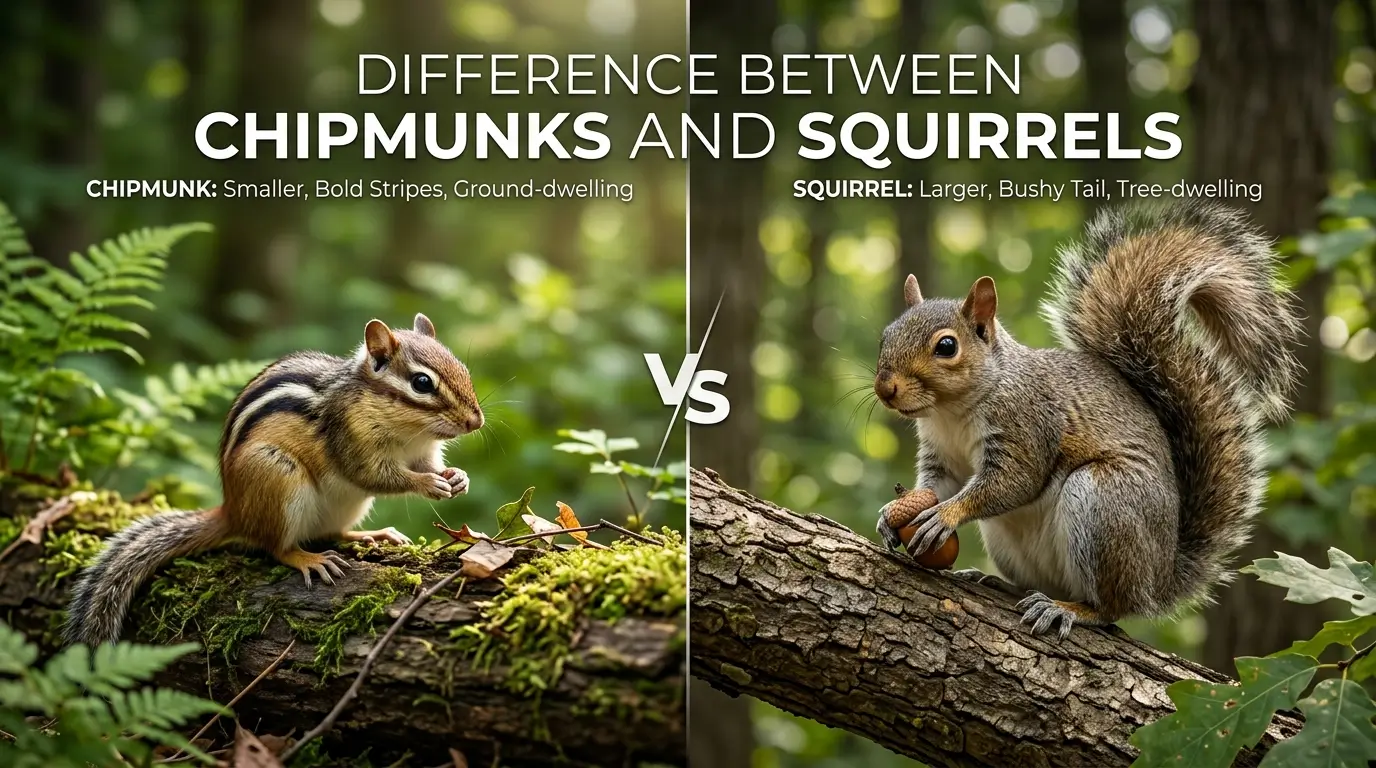
The easiest way to distinguish a chipmunk from a squirrel is by looking at their appearance.
Chipmunks have prominent stripes on their backs and faces. Squirrels usually lack these stripes and have a more uniform coat color.
2. Size
Chipmunks are significantly smaller than most squirrels.
A typical chipmunk measures between 5 and 11 inches, while many squirrels range from 10 to 20 inches or more.
3. Tail Structure
Chipmunks possess relatively short and narrow tails.
Squirrels have large, bushy tails that help with balance, communication, and temperature regulation.
4. Habitat
Chipmunks prefer living underground in burrows.
Squirrels usually build nests in trees or occupy natural tree cavities.
5. Climbing Ability
Although chipmunks can climb trees when necessary, they spend most of their lives on the ground.
Squirrels are expert climbers and can move effortlessly between branches.
6. Food Storage Methods
Chipmunks store food in underground chambers.
Squirrels bury nuts and seeds in multiple locations across their territory.
7. Social Behavior
Chipmunks are generally solitary and territorial.
Squirrels are often more tolerant of others and may gather in areas with abundant food.
8. Vocal Communication
Chipmunks produce high-pitched chirps and squeaks.
Squirrels use a wider range of sounds, including barks, chatters, and warning calls.
9. Geographic Distribution
Chipmunks are primarily found in North America and parts of Asia.
Squirrels are found on nearly every continent except Antarctica and Australia.
10. Species Diversity
There are about 25 recognized chipmunk species.
The squirrel family contains more than 280 species worldwide.
Comparison Table
| Feature | Chipmunk | Squirrel |
| Size | Small | Larger |
| Stripes | Present | Usually absent |
| Tail | Thin | Bushy |
| Habitat | Underground burrows | Trees and nests |
| Activity Area | Ground | Trees and ground |
| Food Storage | Underground chambers | Buried caches |
| Social Behavior | Solitary | More social |
| Climbing Skill | Moderate | Excellent |
| Species Number | Around 25 | More than 280 |
| Distribution | Limited regions | Worldwide |
Similarities Between Chipmunks and Squirrels
Although they have many differences, they also share several similarities:
- Both belong to the Sciuridae family.
- Both are rodents.
- Both consume nuts and seeds.
- Both help spread plant species.
- Both are active during the day.
- Both have sharp front teeth.
- Both serve as prey for larger animals.
- Both contribute to ecosystem health.
Nature and Behavior of Chipmunks
Chipmunks are highly energetic animals that spend much of their time searching for food. They create complex burrow systems containing sleeping chambers, storage rooms, and escape tunnels.
These rodents are very cautious. When threatened, they quickly retreat into their burrows. Their cheek pouches allow them to transport large amounts of food efficiently.
Chipmunks are generally independent and prefer minimal interaction with other chipmunks outside the breeding season.
Nature and Behavior of Squirrels
Squirrels are intelligent, adaptable, and resourceful animals. They spend considerable time climbing trees, searching for food, and avoiding predators.
Many squirrels demonstrate remarkable memory when locating buried food. Their agility allows them to leap impressive distances between branches.
Squirrels are often observed in parks and residential neighborhoods where they have adapted to human presence.
Diet Comparison
What Chipmunks Eat
Chipmunks consume:
- Seeds
- Nuts
- Fruits
- Berries
- Mushrooms
- Insects
- Bird eggs occasionally
What Squirrels Eat
Squirrels consume:
- Nuts
- Seeds
- Fruits
- Tree buds
- Flowers
- Fungi
- Insects occasionally
Both animals are omnivorous and adapt their diets according to seasonal availability.
Why People Confuse Chipmunks and Squirrels
Several factors contribute to this confusion:
Same Family
Both belong to the Sciuridae family, meaning they share many physical traits.
Similar Diets
Both animals collect nuts and seeds, making their behavior appear similar.
Similar Fur Colors
Many species display shades of brown, gray, and reddish fur.
Similar Body Shape
At a quick glance, both possess compact bodies, small ears, and furry tails.
Closer observation reveals their distinctive characteristics.
Which Animal Is Better in Different Situations?
For Studying Ground Behavior
Chipmunks are better examples because they spend most of their lives on the ground and maintain intricate burrow systems.
For Studying Tree Adaptations
Squirrels are superior examples due to their climbing abilities and tree-dwelling lifestyles.
For Urban Wildlife Observation
Squirrels are easier to observe because they commonly inhabit parks and residential areas.
For Learning Food Storage Strategies
Both animals provide excellent examples, though their storage methods differ significantly.
Chipmunks and Squirrels in Metaphors and Similes
Chipmunk Metaphors
- “She is a chipmunk of knowledge, storing information for future use.”
- “The researcher became a chipmunk before the conference.”
Squirrel Metaphors
- “He is a squirrel of opportunity.”
- “The entrepreneur behaved like a squirrel preparing for winter.”
Similes
- Busy as a chipmunk gathering nuts.
- Quick as a squirrel climbing a tree.
- Active like a squirrel in autumn.
- Alert as a chipmunk near its burrow.
Connotative Meanings
Chipmunk
Positive
Represents preparedness and organization.
Example: “Emma is a chipmunk when planning projects.”
Negative
Can suggest excessive hoarding.
Example: “He stores everything like a chipmunk.”
Neutral
A small striped rodent.
Squirrel
Positive
Represents energy and adaptability.
Example: “She works like a squirrel.”
Negative
May suggest distraction.
Example: “He was squirrel-like during the lecture.”
Neutral
A common tree-dwelling rodent.
Idioms and Expressions
To Squirrel Away
Meaning: To save something secretly.
Example: “She squirreled away money for emergencies.”
Busy as a Squirrel
Meaning: Extremely active.
Example: “The team was busy as squirrels before the launch.”
Like a Chipmunk Gathering Nuts
Meaning: Preparing carefully for future needs.
Example: “Students worked like chipmunks before final exams.”
Ecological Importance
Benefits of Chipmunks
- Aerate soil through digging.
- Spread seeds.
- Control insect populations.
- Serve as prey for predators.
- Support forest regeneration.
Benefits of Squirrels
- Plant trees through seed dispersal.
- Maintain forest biodiversity.
- Provide food for predators.
- Assist natural regeneration.
- Contribute to ecosystem balance.
Frequently Asked Questions
1. Are chipmunks and squirrels related?
Yes. Both belong to the Sciuridae family.
2. Can chipmunks climb trees?
Yes, but they spend more time on the ground than squirrels.
3. Which animal is larger?
Squirrels are generally larger than chipmunks.
4. Do both animals store food?
Yes. Chipmunks store food underground, while squirrels bury it in various locations.
5. Are chipmunks more aggressive than squirrels?
Both can defend their territories, but chipmunks tend to be more solitary and territorial.
Final Thoughts on Chipmunks and Squirrels
Chipmunks and squirrels may appear similar at first glance, but they are remarkably different animals.
Their unique adaptations help them thrive in different environments and contribute to ecosystem health in distinct ways. Understanding these differences enhances our appreciation of wildlife and the natural world.
Conclusion
The difference between chipmunks and squirrels extends far beyond their appearance. Chipmunks are smaller, striped, ground-dwelling rodents that rely on burrows and underground food storage. Squirrels are larger, tree-oriented animals known for their bushy tails and exceptional climbing skills.
Both animals play essential ecological roles by dispersing seeds, supporting biodiversity, and contributing to healthy ecosystems.
While people often confuse them because of their shared family background, observing their size, stripes, habitat, and behavior makes identification much easier.
By understanding the difference between chipmunks and squirrels, we gain valuable insight into the fascinating diversity of nature and the important roles these animals play in our environment.

Daniel Carter is a research writer and comparison specialist at Compadiff. He focuses on breaking down complex topics into simple explanations so readers can clearly understand the differences between similar concepts, products, and ideas.