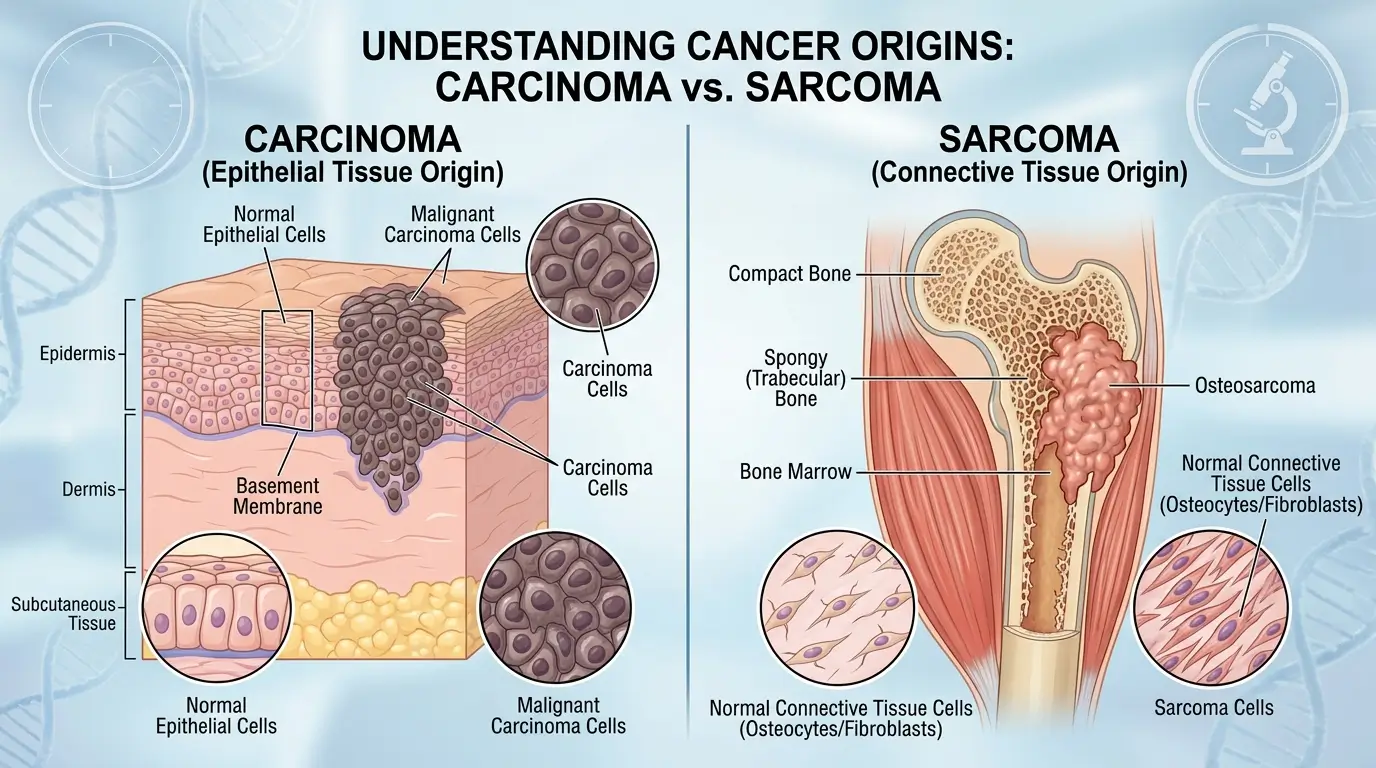
The term difference between carcinoma and sarcoma often appears in medical discussions, especially when talking about different types of cancer. In si
mple words, both are forms of cancer, but they originate from different tissues in the body. The difference between carcinoma and sarcoma becomes very important when doctors diagnose and treat patients, because each behaves in a unique way. In hospitals, two patients may be diagnosed with similar symptoms, yet one may have carcinoma while the other has sarcoma, showing how crucial the difference between carcinoma and sarcoma really is.
Imagine a man visiting a doctor with a lump in his body. One is told it is a skin-related cancer, while another is diagnosed with a bone-related tumor. Both are serious, but their origin and treatment paths differ greatly. Understanding the difference between carcinoma and sarcoma helps medical professionals make accurate decisions and helps learners build a strong foundation in pathology.
Pronunciation
- Carcinoma:
US: /ˌkɑːr.sɪˈnoʊ.mə/
UK: /ˌkɑː.sɪˈnəʊ.mə/ - Sarcoma:
US: /sɑːrˈkoʊ.mə/
UK: /sɑːˈkəʊ.mə/
Linking Hook
Now that we understand the basic meaning and importance of these terms, let’s explore the difference between carcinoma and sarcoma in detail.
Difference Between Carcinoma and Sarcoma
Carcinoma and sarcoma differ in origin, behavior, spread, and treatment. Below are 10 clear points of distinction:
1. Tissue of Origin
- Carcinoma: arises from epithelial cells
- Example 1: Breast cancer
- Example 2: Lung cancer
- Sarcoma: arises from connective tissues
- Example 1: Bone cancer (osteosarcoma)
- Example 2: Muscle tumor (leiomyosarcoma)
2. Location in Body
- Carcinoma: skin, glands, and organs
- Example: liver tumor, skin cancer
- Sarcoma: bones, muscles, fat, cartilage
- Example: thigh bone tumor, fat tissue tumor
3. Frequency
- Carcinoma: very common
- Example: most breast cancers
- Sarcoma: rare
- Example: rare bone cancers
4. Spread Pattern
- Carcinoma: spreads through lymph system
- Example: breast cancer spreading to lymph nodes
- Sarcoma: spreads through blood
- Example: bone sarcoma spreading to lungs
5. Age Group Affected
- Carcinoma: mostly adults and older people
- Example: lung cancer in smokers
- Sarcoma: often young people
- Example: bone sarcoma in teenagers
6. Appearance
- Carcinoma: forms solid tumors
- Example: breast lump
- Sarcoma: forms deep tissue masses
- Example: muscle swelling
7. Growth Rate
- Carcinoma: usually moderate to slow
- Example: prostate cancer
- Sarcoma: often faster growth
- Example: high-grade bone sarcoma
8. Diagnosis Method
- Carcinoma: biopsy and imaging
- Example: mammogram for breast cancer
- Sarcoma: MRI and deep biopsy
- Example: bone scan for osteosarcoma
9. Treatment Approach
- Carcinoma: surgery, radiation, chemotherapy
- Example: breast tumor removal
- Sarcoma: aggressive surgery + chemo
- Example: limb-sparing bone surgery
10. Prognosis
- Carcinoma: better if detected early
- Example: early skin cancer
- Sarcoma: depends on stage and type
- Example: advanced bone sarcoma
Nature and Behavior
Carcinoma behaves like a slow invader, gradually affecting organs and spreading through lymph nodes. It is often detected in later stages because it grows inside epithelial layers.
Sarcoma behaves more aggressively, attacking connective tissues like bones and muscles. It spreads quickly through the bloodstream and often requires immediate treatment.
Why People Get Confused
People confuse carcinoma and sarcoma because both are cancer types ending in “-oma.” Additionally, both can form tumors and cause similar symptoms like swelling, pain, and fatigue. Without medical knowledge, distinguishing them becomes difficult.
Table: Difference and Similarity
| Feature | Carcinoma | Sarcoma |
| Origin | Epithelial cells | Connective tissues |
| Frequency | Common | Rare |
| Spread | Lymph system | Bloodstream |
| Age Group | Adults | Young people |
| Growth | Slower | Faster |
Similarity: Both are malignant cancers and can spread if untreated.
Which is Better in What Situation?
Neither carcinoma nor sarcoma is “better” because both are serious medical conditions. However, carcinoma is often easier to detect early through screenings like mammograms or skin checks, which improves treatment success.
Sarcoma, being rare and deep in tissues, is harder to detect early and often requires more aggressive treatment. In medical research, carcinoma cases provide more data due to their frequency, while sarcoma cases are crucial for studying rare cancer behavior. Understanding both helps doctors choose precise diagnostic and treatment methods.
Metaphors and Similes
- Carcinoma is like a “slow-growing shadow spreading across a wall.”
- Sarcoma is like a “wild fire moving through open land.”
Connotative Meaning
- Carcinoma
- Positive: treatable if early
- Negative: common deadly disease
- Neutral: medical classification
- Sarcoma
- Positive: rare and studied in research
- Negative: aggressive and dangerous
- Neutral: tissue-based cancer type
Idioms / Proverbs Usage
- “A silent enemy within” (used for carcinoma in early stages)
Example: Carcinoma can act as a silent enemy within the body. - “Fast as wildfire” (used for sarcoma spread)
Example: Sarcoma spreads fast as wildfire if untreated.
Literature References
- Cancer: A Biography – Mukherjee Siddhartha (Medical Non-fiction, 2010)
- The Emperor of All Maladies – Siddhartha Mukherjee (Biography/Science, 2010)
- The Fault in Our Cells – Medical Fiction Inspired Works (Modern genre, 2018)
Movies Related to Cancer Themes
- The Fault in Our Stars (2014, USA)
- 50/50 (2011, USA)
- A Walk to Remember (2002, USA)
Frequently Asked Questions
1. Is carcinoma more common than sarcoma?
Yes, carcinoma is far more common worldwide.
2. Which is more dangerous?
Both are dangerous, but sarcoma is often more aggressive.
3. Can both be cured?
Yes, if detected early and treated properly.
4. Do both spread in the same way?
No, carcinoma spreads via lymph nodes while sarcoma spreads through blood.
5. Are they both cancers?
Yes, both are malignant cancers affecting different tissues.
How Both Are Useful for the Surroundings
Though harmful to the body, studying carcinoma and sarcoma helps medical science improve cancer detection, treatment methods, and survival rates. Research on both leads to a better understanding of human biology and the development of advanced therapies that benefit society.
Final Words
Carcinoma and sarcoma may seem similar in name, but they represent two very different types of cancer. One originates from epithelial tissues while the other begins in connective tissues. Their behavior, spread, and treatment methods differ significantly.
Understanding these differences is not just important for medical professionals but also for students and researchers. Awareness helps in early detection, better treatment planning, and improved survival rates. In the end, knowledge of these diseases contributes to saving lives and advancing medical science.
Conclusion
The difference between carcinoma and sarcoma is essential in understanding how different cancers behave in the human body. Carcinoma originates from epithelial tissues such as skin and organs, while sarcoma develops in connective tissues like bones and muscles.
Their spread patterns, growth rates, and treatment methods vary significantly. Carcinoma is more common and often detected through routine screenings, whereas sarcoma is rare and tends to grow aggressively.
Recognizing the difference between carcinoma and sarcoma helps doctors choose accurate treatments and improve patient outcomes. It also supports medical research and education by clarifying how different cancers operate. Ultimately, awareness of both conditions contributes to early diagnosis, better care, and improved survival rates in society.

Sophia Bennett is a content researcher and editor at Compadiff, where she specializes in creating clear and engaging comparison articles. Her work focuses on explaining differences in health, lifestyle, education, and everyday topics in a way that is easy for readers to understand.