Imagine two friends shopping for clothes. One points to a jacket and says “This fabric is thick.” The other laughs and replies, “I thought you meant someone was fat!” This simple misunderstanding shows why many English learners confuse these two words.
Although both words can describe size or appearance they have very different meanings and uses.
The difference between thick and fat is important because these words are used in different contexts. Understanding the difference between thick and fat helps learners communicate accurately and avoid awkward situations.
Whether describing a person an object or a substance knowing the difference between thick and fat improves both speaking and writing skills. This guide explains the difference between thick and fat in a simple and practical way.
Pronunciation
| Word | US Pronunciation | UK Pronunciation |
|---|---|---|
| Thick | /θɪk/ | /θɪk/ |
| Fat | /fæt/ | /fæt/ |
Before exploring the details let’s understand how these commonly used words differ in meaning purpose and usage.
Key Difference Between Thick and Fat
Thick generally refers to something having a large distance between opposite sides or being dense and heavy in consistency.
Fat usually refers to excess body flesh oily substances or a person/animal having a larger amount of body weight.
Why Is Their Difference Necessary to Know?
Understanding these words is important for students, professionals, writers, and language learners.
- Prevents misunderstandings in communication.
- Helps use descriptive language correctly.
- Improves vocabulary accuracy.
- Makes writing more professional.
- Encourages respectful communication when describing people.
- Helps experts in health, nutrition, literature, and linguistics explain concepts clearly.
Difference Between Thick and Fat
1. Basic Meaning
Thick
Describes width, density, or consistency.
Examples:
- The book is thick.
- The soup is thick.
Fat
Describes excess body weight or oily substances.
Examples:
- The cat became fat.
- Butter contains fat.
2. Usage for Objects
Thick
Commonly used for objects.
Examples:
- Thick walls protect the house.
- She wore a thick coat.
Fat
Rarely used for objects.
Examples:
- Fat candle (traditional usage).
- Fat rope (less common usage).
3. Usage for People
Thick
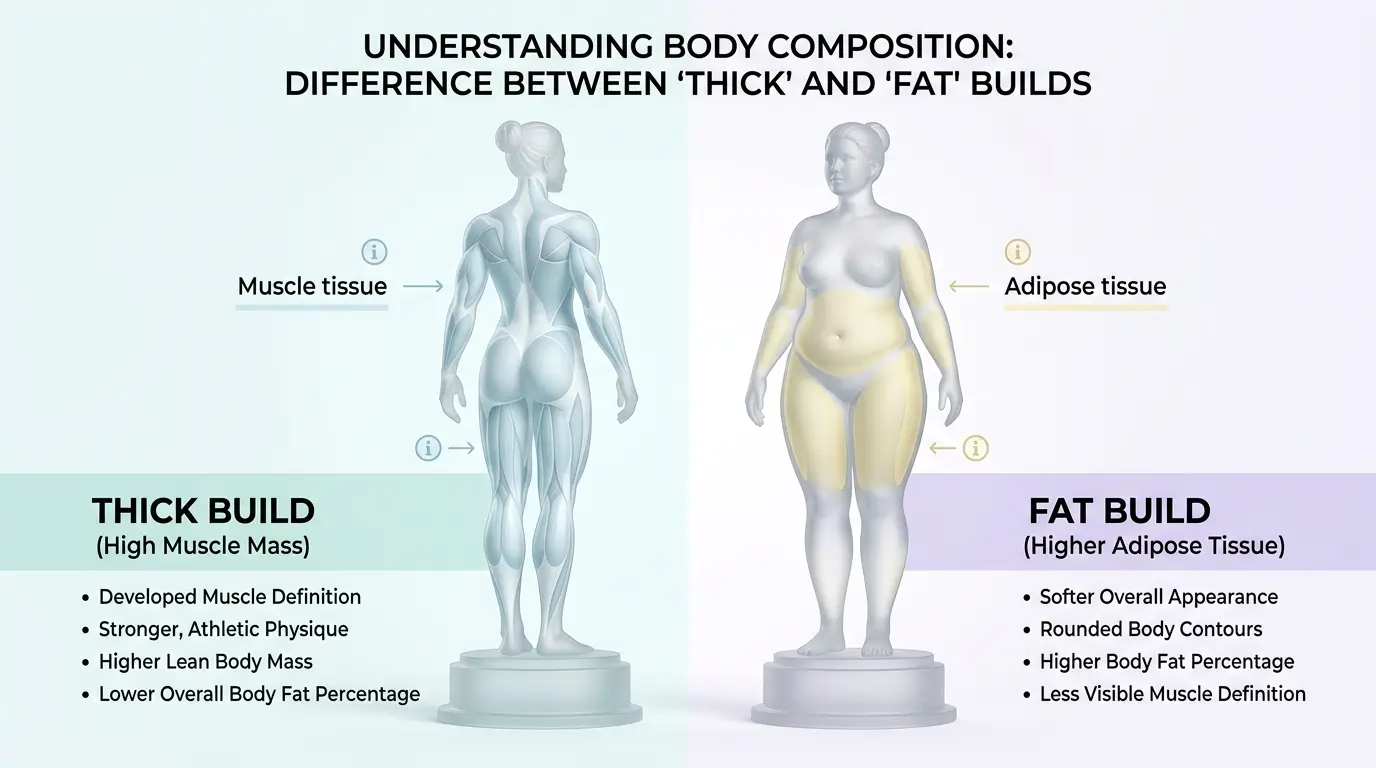
Can describe a curvy body shape informally.
Examples:
- She has thick legs.
- The athlete has a thick build.
Fat
Directly refers to body weight.
Examples:
- The dog is fat.
- He became fat after retirement.
4. Medical Context
Thick
Refers to tissues or substances.
Examples:
- Thick skin.
- Thick blood.
Fat
Refers to body fat and nutrition.
Examples:
- Body fat percentage.
- Fat accumulation.
5. Texture Description
Thick
Frequently describes texture.
Examples:
- Thick cream.
- Thick paint.
Fat
Not commonly used for texture.
Examples:
- Fat meat.
- Fat layer.
6. Emotional Impact
Thick
Usually neutral.
Examples:
- Thick blanket.
- Thick forest.
Fat
Can be sensitive or negative.
Examples:
- Fat jokes hurt feelings.
- Calling someone fat may be offensive.
7. Scientific Usage
Thick
Used in physics and engineering.
Examples:
- Thick material.
- Thick layer of insulation.
Fat
Used in biology and nutrition.
Examples:
- Saturated fat.
- Healthy fat.
8. Slang Usage
Thick
Can mean attractive and curvy.
Examples:
- She looks thick.
- Thick figure.
Fat
Can mean large or abundant.
Examples:
- Fat paycheck.
- Fat profit.
9. Describing Substances
Thick
Very common.
Examples:
- Thick sauce.
- Thick fog.
Fat
Refers to oily content.
Examples:
- Animal fat.
- Fat deposits.
10. Grammatical Flexibility
Thick
Used widely as an adjective.
Examples:
- Thick hair.
- Thick notebook.
Fat
Functions as noun and adjective.
Examples:
- Fat is essential for health.
- Fat pig.
Nature and Behaviour of Both
Thick
- Describes physical density.
- Often neutral.
- Used for materials, liquids, forests, hair, and books.
- Indicates size or consistency.
Fat
- Describes body composition.
- Can be positive, neutral, or negative depending on context.
- Common in health and nutrition discussions.
- Often associated with body weight.
Why Are People Confused About Their Use?
People confuse these words because both can suggest “largeness” or “fullness.” In informal speech some speakers use “thick” when discussing body shape while “fat” directly refers to body weight. Their overlap in describing physical appearance often causes confusion.
Difference and Similarity Table
| Feature | Thick | Fat | Similarity |
|---|---|---|---|
| Describes Size | Yes | Yes | Both can indicate largeness |
| Used for People | Sometimes | Yes | Both may describe appearance |
| Used for Objects | Common | Rare | Both can describe physical things |
| Used in Science | Yes | Yes | Technical applications |
| Refers to Weight | No | Yes | Physical characteristics |
| Refers to Density | Yes | No | Descriptive adjectives |
| Can Be Offensive | Rarely | Sometimes | Depends on context |
Which Is Better in What Situation?
When Thick Is Better
The word “thick” is better when discussing density, width, texture, or consistency. It is appropriate for describing books, forests, liquids, clothing, hair, and materials. In modern informal language, it may also describe a curvy body shape without directly focusing on weight.
When Fat Is Better
The word “fat” is better when discussing nutrition, biology, health, or body composition. It accurately describes body fat, dietary fats, and medical conditions. It should be used carefully when referring to people because some may find it sensitive.
How the Words Are Used in Metaphors and Similes
Thick
Metaphors:
- Thick as a jungle of thoughts.
- Thick with mystery.
Similes:
- Thick as mud.
- Thick as fog.
Fat
Metaphors:
- A fat wallet.
- Fat profits.
Similes:
- Fat as a pig.
- Fat as a bear before winter.
Connotative Meanings
Thick
Positive
- Thick hair.
- Thick eyebrows.
Neutral
- Thick wall.
- Thick notebook.
Negative
- Thick-headed (slow to understand).
Fat
Positive
- Fat paycheck.
- Fat profits.
Neutral
- Body fat.
- Animal fat.
Negative
- Fat insult.
- Fat stereotype.
Idioms and Proverbs
Thick
- Through thick and thin
- We remained friends through thick and thin.
- Thick as thieves
- The brothers are thick as thieves.
Fat
- Live off the fat of the land
- They lived off the fat of the land.
- A fat chance
- You have a fat chance of winning without practice.
Works in Literature
Thick
- The Thick and the Lean — Chana Orloff (Novel, 1958)
- Through Thick and Thin — Various authors (Memoir collections)
Fat
- Fat Is a Feminist Issue — Susie Orbach (Non-fiction, 1978)
- Fat Chance — Robert H. Lustig (Health, 2012)
- Fat Girl — Judith Moore (Memoir, 1987)
Movies Related to the Keywords
Fat
- Fat Girl (2001, France)
- Fat Albert (2004, USA)
- Baby Fat (2019, UK)
Thick
There are no major internationally recognized films specifically titled “Thick” that achieved widespread prominence.
Frequently Asked Questions
1. Is thick the same as fat?
No. Thick usually refers to density or width, while fat refers to body fat or oily substances.
2. Can thick describe a person?
Yes. Informally, it can describe a curvy or muscular body shape.
3. Is fat always negative?
No. In nutrition and science, it is a neutral term.
4. Which word is more appropriate for health discussions?
Fat is more appropriate because it relates directly to body composition.
5. Can thick describe liquids?
Yes. Thick is commonly used for soups, sauces, and creams.
How Both Are Useful for Surroundings
Thick materials help provide insulation, protection, and durability. Thick forests support biodiversity and environmental balance.
Fat serves as an energy reserve in animals and humans. Natural fats also play important roles in ecosystems and food chains.
Final Words for Both
“Thick” emphasizes density, width, and consistency, while “fat” emphasizes body composition, weight, and oily substances. Choosing the correct word depends on the context and intended meaning.
Conclusion
The difference between thick and fat may seem small at first, but it is significant in English communication. Thick primarily describes density width texture or consistency whereas fat relates to body weight body composition or oily substances.
Both words have literal and figurative meanings and can be used in various professional and everyday contexts. By understanding their definitions examples connotations and practical uses learners can communicate more accurately and confidently.
Whether writing academic content speaking casually or studying English vocabulary mastering the distinction between these two words helps avoid confusion and improves language skills.

Sophia Bennett is a content researcher and editor at Compadiff, where she specializes in creating clear and engaging comparison articles. Her work focuses on explaining differences in health, lifestyle, education, and everyday topics in a way that is easy for readers to understand.