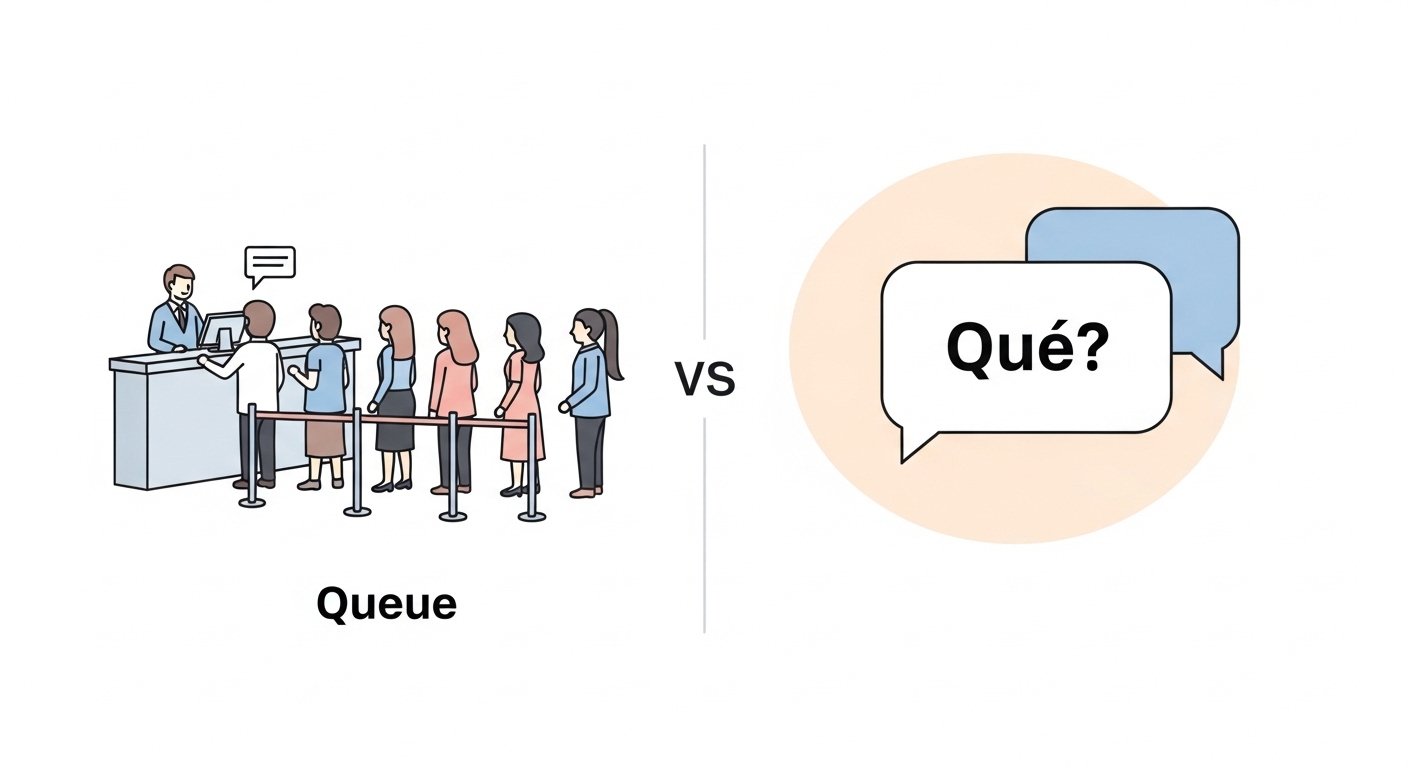
Imagine you’re chatting with a friend online and suddenly they type “que?” while you’re standing in a long line at a ticket counter called a “queue.” These two words may look somewhat similar, but their meanings and usage are completely different. Understanding the difference between que and queue becomes important in everyday communication, especially in writing and digital conversations.
The difference between que and queue often confuses learners because both words appear in English contexts, yet they belong to different linguistic backgrounds. While “queue” is a proper English word, “que” is usually borrowed from other languages like Spanish or French. Knowing the difference between que and queue helps avoid embarrassing mistakes in professional writing and casual messaging.
In simple terms, the difference between que and queue lies in meaning, origin, pronunciation, and usage. Let’s break it down clearly so both beginners and experts can master it.
Key Difference Between the Both
The main difference is that “queue” is an English noun meaning a line of people or items, while “que” is not a standard English word and is mostly used in other languages or informal texting.
Why Is Their Difference Important?
Understanding the difference between que and queue is essential for both learners and professionals. In academic or professional writing, using “que” instead of “queue” can make your work look incorrect or unpolished.
For learners, it improves vocabulary accuracy and communication skills. For experts, especially writers and educators, clarity in language ensures credibility. In society, proper word usage avoids confusion in instructions, signs, and digital communication.
Pronunciation (US & UK)
- Queue
- US: /kjuː/ (sounds like “cue”)
- UK: /kjuː/
- Que
- Spanish: /ke/ (sounds like “keh”)
- French: /kə/ or /k/ depending on context
Linking Hook
Now that you understand the basics, let’s explore the difference between que and queue in detail with clear comparisons, examples, and practical usage.
Difference Between Que and Queue
1. Meaning
- Queue: A line of people or items waiting
- Example 1: I stood in a queue at the bank.
- Example 2: There was a long queue for tickets.
- Que: Means “what” or “that” in Spanish/French
- Example 1: ¿Que quieres? (What do you want?)
- Example 2: Elle dit que tu viens. (She says that you are coming.)
2. Language Origin
- Queue: English (from French origin but fully adopted)
- Example 1: Queue system in airports
- Example 2: Online queue for tickets
- Que: Spanish/French word
- Example 1: Spanish conversations
- Example 2: French grammar usage
3. Usage Context
- Queue: Formal and everyday English
- Example 1: Queue at a supermarket
- Example 2: Digital queue in apps
- Que: Informal English texting or foreign language
- Example 1: “Que?” in chat
- Example 2: Spanish writing
4. Part of Speech
- Queue: Noun (sometimes verb)
- Example 1: Join the queue
- Example 2: Queue the files
- Que: Conjunction/pronoun (in other languages)
- Example 1: Spanish clause
- Example 2: French sentence
5. Correctness in English
- Queue: Correct English word
- Example 1: Queue management
- Example 2: Queue system
- Que: Incorrect in standard English
- Example 1: Wrong: “Que are you doing?”
- Example 2: Correct: “What are you doing?”
6. Pronunciation
- Queue: “kyoo”
- Example 1: Queue line
- Example 2: Music queue
- Que: “keh” or “kə”
- Example 1: Spanish speaking
- Example 2: French phrases
7. Frequency of Use
- Queue: Common in daily English
- Example 1: Public places
- Example 2: Online systems
- Que: Rare in English
- Example 1: Slang
- Example 2: Foreign use
8. Spelling Complexity
- Queue: Complex spelling (5 letters, 1 sound)
- Example 1: Silent letters
- Example 2: Hard for beginners
- Que: Simple spelling
- Example 1: Easy to write
- Example 2: Short form
9. Field of Use
- Queue: Technology, public services
- Example 1: Data queue
- Example 2: Waiting line
- Que: Linguistics, foreign language
- Example 1: Grammar studies
- Example 2: Language learning
10. Formality Level
- Queue: Formal and informal
- Example 1: Office use
- Example 2: Casual use
- Que: Mostly informal or foreign
- Example 1: Texting slang
- Example 2: Language-specific
Nature and Behaviour
- Queue: Structured, organized, represents order and patience
- Que: Flexible, contextual, depends on language rules
Why People Are Confused?
People confuse them because of similar spelling and pronunciation. Also, social media and multilingual exposure make “que” appear in English contexts, increasing confusion.
Comparison Table
| Feature | Queue | Que |
| Meaning | Line or waiting list | “What/that” (Spanish/French) |
| Language | English | Spanish/French |
| Usage | Formal & daily use | Informal/foreign |
| Pronunciation | kyoo | keh/kə |
| Correct in English | Yes | No (mostly) |
| Nature | Structured | Contextual |
| Similarity | Both are short words | Both appear in communication |
Which Is Better in What Situation?
Queue:
“Queue” is better in all English writing situations where you want to describe a line, order, or waiting system. It is appropriate for academic, professional, and casual communication. Whether you are talking about people waiting in a bank or tasks waiting in a computer system, “queue” is the correct and reliable word.
Que:
“Que” is only better when you are writing in Spanish or French, or using informal chat slang. In English writing, it should generally be avoided unless you are quoting another language.
Metaphors and Similes
- Queue: “Life is like a queue—everyone gets their turn.”
- Que: Rare in metaphors, mostly linguistic
Connotative Meaning
- Queue: Neutral (sometimes positive—order, patience)
- Example: A well-managed queue shows discipline.
- Que: Neutral (language-specific)
- Example: Used naturally in Spanish communication.
Idioms or Proverbs
- No direct idioms for “que”
- Related to queue:
- “Jump the queue”
- Example: He tried to jump the queue at the store.
- “Jump the queue”
Works in Literature
- Queue:
- “The Queue” – Novel, Basma Abdel Aziz, 2013
- Que:
- Appears widely in Spanish and French literature
Movies Related to the Words
- Queue:
- No major movie directly titled “Queue”
- Que:
- “¿Qué culpa tiene el niño?” (2016, Mexico)
FAQs
1. Is “que” a correct English word?
No, it is not standard English.
2. What does “queue” mean?
It means a line of people or things waiting.
3. Why is “queue” spelled so strangely?
It comes from French origin, keeping its original spelling.
4. Can I use “que” in texting?
Yes, but only informally or jokingly.
5. How can I remember the difference?
Think: “queue = line,” “que = foreign word.”
How Both Are Useful in Surroundings
“Queue” helps maintain order in public places and systems. “Que” is useful in multilingual communication, especially in Spanish-speaking environments.
Final Words for Both
“Queue” represents structure and clarity in English, while “que” reflects linguistic diversity and cultural expression.
Conclusion
The difference between que and queue is simple yet important. While “queue” is a standard English word used in everyday situations to describe lines or sequences, “que” belongs to other languages and should not be used in formal English writing.
Understanding this distinction improves communication accuracy and avoids confusion. Whether you are a student, writer, or professional, mastering the difference between que and queue ensures your language remains clear, correct, and effective in all contexts.

Daniel Carter is a research writer and comparison specialist at Compadiff. He focuses on breaking down complex topics into simple explanations so readers can clearly understand the differences between similar concepts, products, and ideas.