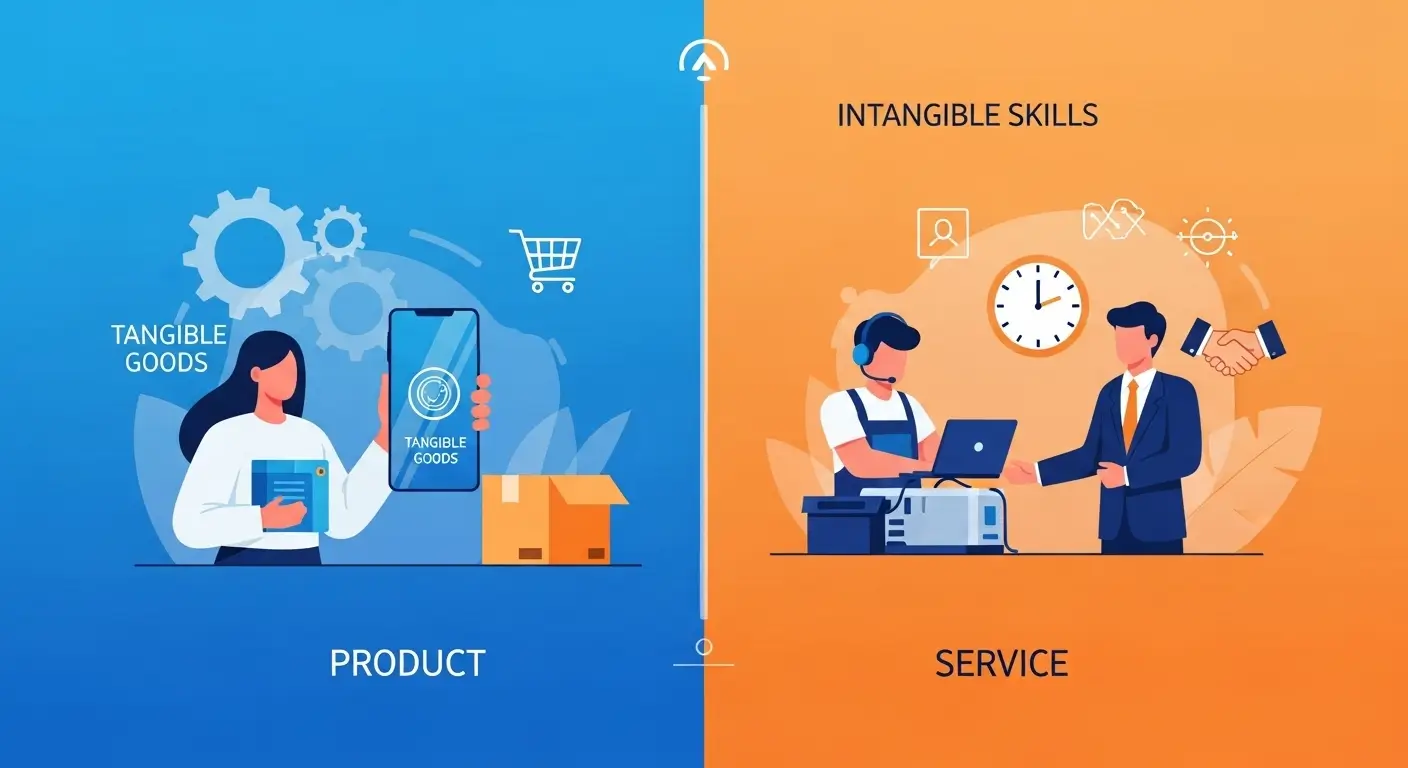
Imagine you walk into a store and buy a smartphone. You leave with a physical item in your hand that is a product. Later, you visit a technician to set up the phone and transfer your data that assistance is a service. This simple situation clearly explains the difference between product and service in everyday life.
Understanding the difference between product and service helps us make smarter purchasing decisions and understand how businesses operate. While both products and services satisfy customer needs, they do so in completely different ways. The difference between product and service lies mainly in tangibility, ownership, and delivery. Learning the difference between product and service is useful not only for students and professionals but also for consumers who interact with businesses daily.
Pronunciation of Product and Service
| Word | US Pronunciation | UK Pronunciation |
| Product | /ˈprɑː.dʌkt/ | /ˈprɒd.ʌkt/ |
| Service | /ˈsɝː.vɪs/ | /ˈsɜː.vɪs/ |
Why Knowing the Difference Matters
In today’s economy, both products and services play a major role in shaping industries, employment, and daily life. Understanding their differences helps businesses design better strategies and helps customers choose wisely. Students in business, marketing, and economics especially need to understand this distinction because it affects pricing, quality control, customer satisfaction, and branding.
Linking hook:
To understand how these two concepts function differently in the real world, let’s explore the key differences between product and service in detail.
Difference Between Product and Service
Key Differences Explained in 10 Points
1. Tangibility
A product is physical and can be touched or seen, while a service is intangible and cannot be physically held.
Product examples:
- Laptop
- Book
Service examples:
- Laptop repair
- Book editing
2. Ownership
When you buy a product, ownership is transferred to you. Services, however, cannot be owned.
Product examples:
- Buying a car
- Purchasing furniture
Service examples:
- Car rental
- Interior design consultation
3. Storage
Products can be stored for future use. Services cannot be stored because they are produced and consumed at the same time.
Product examples:
- Packaged food
- Clothes in a wardrobe
Service examples:
- Haircut
- Online tutoring session
4. Standardization
Products are usually standardized and identical. Services vary depending on who provides them.
Product examples:
- Bottled water
- Smartphones of the same model
Service examples:
- Customer support experience
- Restaurant service quality
5. Production and Consumption
Products are produced first and consumed later. Services are produced and consumed simultaneously.
Product examples:
- Manufactured toys
- Printed magazines
Service examples:
- Live concert performance
- Medical checkup
6. Quality Measurement
Product quality can be tested before purchase. Service quality is judged after experiencing it.
Product examples:
- Checking fabric quality
- Inspecting electronic specifications
Service examples:
- Hotel hospitality
- Taxi driver behavior
7. Return and Replacement
Products can be returned or replaced. Services usually cannot be reversed once delivered.
Product examples:
- Returning defective shoes
- Exchanging a faulty phone
Service examples:
- Legal consultation
- Wedding photography session
8. Customer Interaction
Services involve direct interaction between provider and customer, while products may not.
Product examples:
- Buying groceries online
- Purchasing a watch
Service examples:
- Therapy session
- Fitness coaching
9. Customization
Products are mass-produced, while services are often tailored to individual needs.
Product examples:
- Factory-made chairs
- Packaged snacks
Service examples:
- Custom software development
- Personal tutoring
10. Perishability
Products last for a long time; services are perishable and time-bound.
Product examples:
- Durable appliances
- Stored stationery
Service examples:
- Airline seat for a missed flight
- Expired spa appointment
Nature and Behaviour of Product and Service
Nature of Product
Products are tangible, durable, and separable from the seller. They can be tested, stored, and resold.
Nature of Service
Services are intangible, time-bound, and depend heavily on human interaction. Their quality may vary depending on the provider’s skill and behavior.
Why People Are Confused About Their Use
People often confuse products and services because many businesses offer both together. For example, when you buy a smartphone, you also receive installation, warranty, and customer support services. This blending of tangible and intangible benefits makes it difficult to clearly separate the two concepts in real life.
Table Showing Difference and Similarity
| Feature | Product | Service | Similarity |
| Nature | Tangible | Intangible | Both satisfy needs |
| Ownership | Transferable | Not transferable | Both involve payment |
| Storage | Can be stored | Cannot be stored | Both require resources |
| Quality | Measurable before use | Judged after use | Both affect customer satisfaction |
| Production | Before consumption | During consumption | Both involve production process |
Which Is Better in What Situation?
When a Product Is Better
A product is better when the customer needs something durable and reusable. For example, buying a washing machine is more practical than repeatedly paying for laundry services if you need frequent use.
When a Service Is Better
A service is better when specialized skills or temporary assistance is required. Hiring a mechanic or doctor is more efficient than trying to perform those tasks yourself without expertise.
Metaphors and Similes
- “A product is like a tool in your hand; a service is like a helping hand beside you.”
- “Buying a product is like owning a book, while using a service is like attending a lecture.”
Connotative Meanings
| Word | Connotation | Example |
| Product | Neutral to positive | “This product reflects innovation.” |
| Service | Positive | “Public service builds trust in society.” |
Idioms and Proverbs Related to Service
- “At your service” – ready to help
Example: The assistant said, “I am at your service anytime.” - “Lip service” – expressing support without action
Example: The company paid lip service to customer satisfaction but did nothing.
Works in Literature Featuring Product or Service Themes
- “The Jungle” – Upton Sinclair, 1906 (Genre: Social novel)
- “Death of a Salesman” – Arthur Miller, 1949 (Genre: Drama)
Movies Based on Product or Service Themes
- “The Founder” – 2016, USA (focus on product standardization and service system)
- “Joy” – 2015, USA (product invention and commercialization)
Frequently Asked Questions
1. What is the main difference between product and service?
A product is a physical item, while a service is an activity or assistance provided to meet a need.
2. Can a business offer both product and service?
Yes, most modern businesses combine products with services, such as smartphones with after-sales support.
3. Why are services harder to evaluate?
Because they are intangible and depend on human performance, which varies.
4. Are digital downloads products or services?
They are often considered products because they are deliverable items, even though they are intangible.
5. Which contributes more to the economy?
In many countries, the service sector contributes more to GDP than the product sector.
How Both Are Useful for Society
Products make life convenient by providing tools, machines, and goods that support daily activities. Services, on the other hand, support well-being through healthcare, education, transportation, and communication. Together, they form the backbone of modern economies and improve quality of life.
Final Words on Product and Service
Both products and services are essential elements of business and society. While products offer ownership and durability, services provide expertise and convenience. Neither is superior; their value depends entirely on the situation and user needs.
Conclusion
Understanding the difference between product and service helps individuals make informed choices and helps businesses create better strategies. Products give us physical solutions we can keep and use repeatedly, while services provide skills and experiences that solve problems instantly. In today’s world, the line between them is becoming blurred as companies combine both to deliver complete customer experiences.
However, recognizing their distinct characteristics tangibility, ownership, storage, and customization remains essential for students, professionals, and consumers alike. By learning these differences, we become smarter buyers and more aware participants in the global economy.

Daniel Carter is a research writer and comparison specialist at Compadiff. He focuses on breaking down complex topics into simple explanations so readers can clearly understand the differences between similar concepts, products, and ideas.