Imagine a child learning to ride a bicycle. When the child falls, the parents worry about broken bones. But when the child bends their knees or elbows, something softer and more flexible quietly supports the movement cartilage. This simple everyday situation highlights the difference between bone and cartilage in our body.
The difference between bone and cartilage is an important concept in biology and medicine. Bones are hard, strong tissues that form the framework of the human body, while cartilage is a softer and more flexible connective tissue that cushions joints and supports certain body parts. Understanding the difference between bone and cartilage helps students, doctors, and health professionals understand how the body moves and protects itself.
In fact, the difference between bone and cartilage explains why joints can move smoothly, why babies have softer skeletons, and why injuries in different tissues heal differently.
Key Difference Between Bone and Cartilage
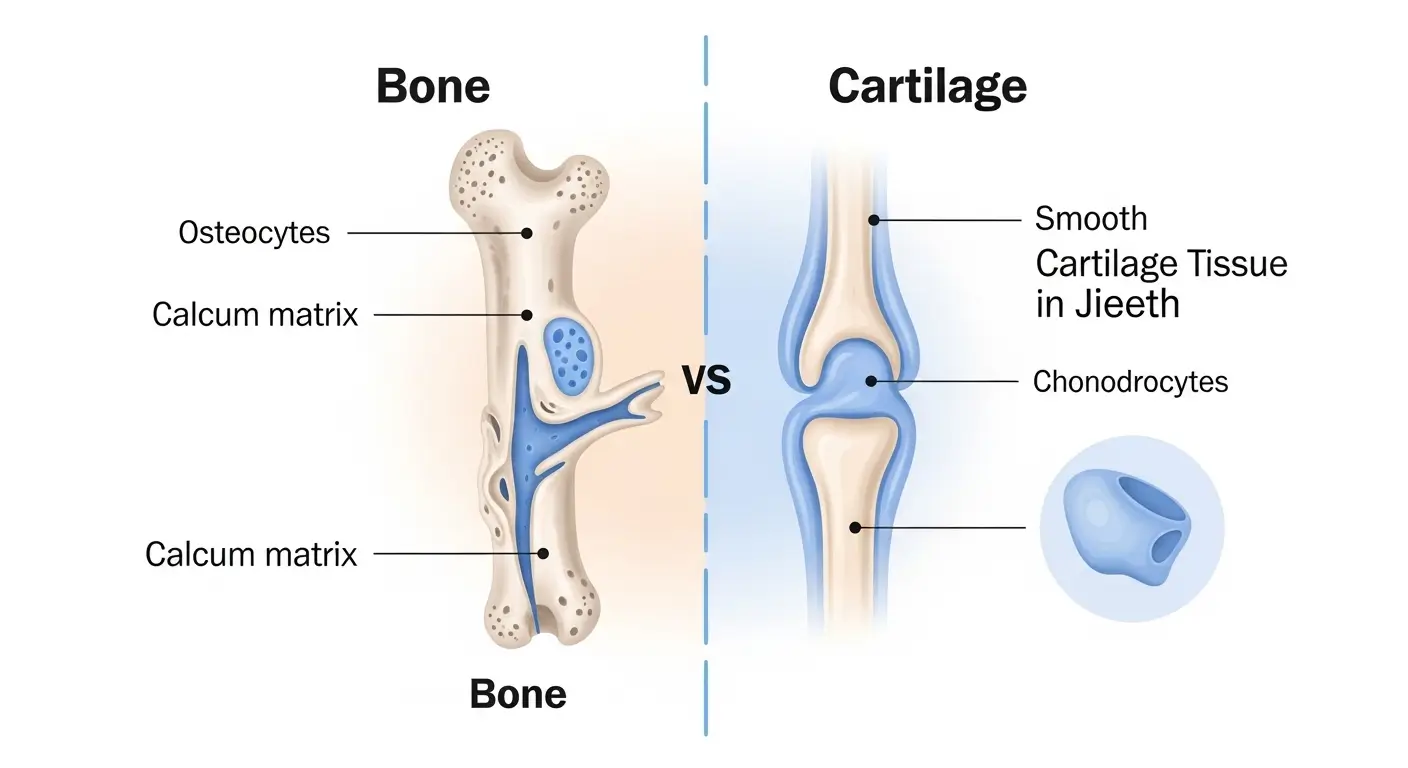
The main difference between bone and cartilage lies in their structure and rigidity.
- Bone is a hard, mineralized connective tissue that forms the skeleton and protects internal organs.
- Cartilage is a flexible connective tissue that supports structures and reduces friction in joints.
Why Their Difference Is Necessary to Know for Learners and Experts
Understanding the difference between bone and cartilage is essential for students, doctors, physiotherapists, and researchers.
For learners, it builds a basic understanding of how the skeletal system works. Students studying biology or medicine must clearly understand how these tissues function differently in the body.
For experts such as orthopedic surgeons or physiotherapists, knowing the difference helps diagnose injuries and treat conditions like arthritis or fractures. In society, this knowledge improves healthcare, rehabilitation, and sports science. For example, protecting cartilage in athletes prevents long-term joint damage, while understanding bone strength helps prevent osteoporosis.
Pronunciation
Bone
- US: /boʊn/
- UK: /bəʊn/
Cartilage
- US: /ˈkɑːrtɪlɪdʒ/
- UK: /ˈkɑːtɪlɪdʒ/
Linking Hook
Now that we understand the basic idea behind these tissues, let’s explore the difference between bone and cartilage in detail by examining their structure, function, and behavior.
Difference Between Bone and Cartilage
1. Structure
Bone: Bones are dense and hard because they contain calcium phosphate minerals.
Examples:
- The femur (thigh bone) supports body weight.
- The skull protects the brain.
Cartilage: Cartilage is soft and flexible with fewer minerals.
Examples:
- Cartilage in the nose allows shape and flexibility.
- Cartilage in the ear helps maintain its structure.
2. Blood Supply
Bone: Bones have a rich blood supply.
Examples:
- Bone fractures heal relatively faster due to blood circulation.
- Bone marrow receives nutrients through blood vessels.
Cartilage: Cartilage has no direct blood supply.
Examples:
- Knee cartilage heals slowly after injury.
- Joint cartilage receives nutrients from surrounding fluid.
3. Hardness
Bone: Bones are rigid and strong.
Examples:
- The rib bones protect the heart and lungs.
- The spine bones support body posture.
Cartilage: Cartilage is softer and elastic.
Examples:
- Cartilage in joints allows smooth movement.
- Cartilage in the trachea keeps airways open.
4. Cells Present
Bone: Bone contains cells called osteocytes.
Examples:
- Osteocytes maintain bone strength.
- They help repair damaged bone tissue.
Cartilage: Cartilage contains chondrocytes.
Examples:
- Chondrocytes produce cartilage matrix.
- They maintain cartilage flexibility.
5. Function
Bone: Bones provide structure and protection.
Examples:
- The skull protects the brain.
- Leg bones support body weight.
Cartilage: Cartilage cushions and supports movement.
Examples:
- Knee cartilage absorbs shock while walking.
- Spinal cartilage allows flexibility.
6. Growth
Bone: Bones grow through ossification.
Examples:
- Children’s bones grow longer during development.
- Growth plates in bones allow height increase.
Cartilage: Cartilage grows through cell division in the matrix.
Examples:
- Ear cartilage grows slowly.
- Nasal cartilage adapts with facial development.
7. Healing Ability
Bone: Bones heal relatively faster.
Examples:
- Broken arms can heal within weeks.
- Bone fractures repair through new bone formation.
Cartilage: Cartilage heals slowly due to lack of blood supply.
Examples:
- Knee cartilage injuries take months to recover.
- Joint cartilage damage may require surgery.
8. Location
Bone: Bones are present throughout the skeleton.
Examples:
- Arms and legs contain long bones.
- The pelvis supports body organs.
Cartilage: Cartilage exists mainly in joints and soft structures.
Examples:
- Found between vertebrae in the spine.
- Present in ears and nose.
9. Weight
Bone: Bones are heavier due to minerals.
Examples:
- Femur is one of the strongest bones.
- Hip bones carry body weight.
Cartilage: Cartilage is lightweight.
Examples:
- Ear cartilage is very light.
- Nasal cartilage allows flexibility without heaviness.
10. Role in Movement
Bone: Bones act as levers for muscles.
Examples:
- Arm bones help lift objects.
- Leg bones help walking and running.
Cartilage: Cartilage reduces friction in joints.
Examples:
- Knee cartilage allows smooth bending.
- Shoulder cartilage prevents joint damage.
Nature and Behaviour
Bone:
Bones are rigid, durable, and protective. They form the structural framework of the body and support body weight.
Cartilage:
Cartilage is flexible and resilient. It acts as a cushion and allows smooth joint movement.
Why People Are Confused About Their Use
People often confuse bone and cartilage because both are connective tissues and are part of the skeletal system. Additionally, cartilage gradually turns into bone during human development, which further creates confusion for learners.
Table: Difference and Similarity Between Bone and Cartilage
| Feature | Bone | Cartilage | Similarity |
| Hardness | Hard | Flexible | Both are connective tissues |
| Blood supply | Present | Absent | Both support body structure |
| Cells | Osteocytes | Chondrocytes | Both have specialized cells |
| Healing | Faster | Slower | Both can repair damage |
| Function | Support & protection | Cushion & flexibility | Both help body movement |
Which Is Better in What Situation?
Bone:
Bones are better when the body needs strength and protection. For example, the skull protects the brain and ribs protect vital organs. Bones also provide support for muscles and help in body posture.
Cartilage:
Cartilage is better when flexibility and cushioning are required. It prevents friction in joints and absorbs shock during physical activities like running or jumping.
Use in Metaphors and Similes
Bone
- “Strong to the bone” (meaning extremely strong)
Example: The athlete was determined to win, strong to the bone.
Cartilage
- Often used metaphorically to describe flexibility or softness.
Example: His attitude was flexible like cartilage in a joint.
Connotative Meaning
Bone
- Positive: strength and stability
Example: “She has bone-strong determination.” - Neutral: body structure
Example: “The doctor examined the bone injury.”
Cartilage
- Neutral: flexibility and cushioning
Example: “Cartilage protects the joints.”
Idioms or Proverbs
Bone-related idioms
- “Bone of contention”
Example: The property dispute became the bone of contention between the brothers. - “Work one’s fingers to the bone”
Example: She worked her fingers to the bone to support her family.
Works in Literature
Bone
- Bone: The Complete Cartoon Epic Graphic Fantasy Jeff Smith 2004
Cartilage
- Cartilage is rarely used directly in literature titles but appears in medical and scientific writings.
Movies Related to the Keywords
Bone
- Winter’s Bone 2010 USA
- The Lovely Bones 2009 USA/New Zealand
Cartilage
- No major films specifically titled with cartilage, but it appears in medical documentaries.
Frequently Asked Questions
1. What is the main difference between bone and cartilage?
Bone is hard and mineralized, while cartilage is flexible and softer.
2. Why does cartilage heal slower than bone?
Cartilage lacks blood vessels, which slows its healing process.
3. Where is cartilage found in the body?
It is found in joints, ears, nose, and between vertebrae.
4. Can cartilage turn into bone?
Yes, during development cartilage gradually transforms into bone through ossification.
5. Which is stronger: bone or cartilage?
Bone is stronger and harder than cartilage.
How Both Are Useful for Surroundings
Bones and cartilage are essential for the human body to function normally. Bones provide support, protection, and movement, while cartilage ensures smooth joint motion and flexibility. Together they maintain mobility, posture, and structural stability.
Final Words for Both
Bone represents strength and protection, while cartilage symbolizes flexibility and support. Both tissues complement each other to maintain a healthy skeletal system.
Conclusion
The difference between bone and cartilage lies mainly in their structure, function, and flexibility. Bones form the strong framework of the body and protect vital organs, while cartilage provides cushioning and allows smooth movement in joints. Both tissues play essential roles in human health and mobility.
Understanding the difference between bone and cartilage helps learners grasp fundamental biological concepts and assists medical professionals in diagnosing and treating skeletal conditions. Ultimately, bones and cartilage work together to maintain balance, flexibility, and strength in the human body.

Daniel Carter is a research writer and comparison specialist at Compadiff. He focuses on breaking down complex topics into simple explanations so readers can clearly understand the differences between similar concepts, products, and ideas.