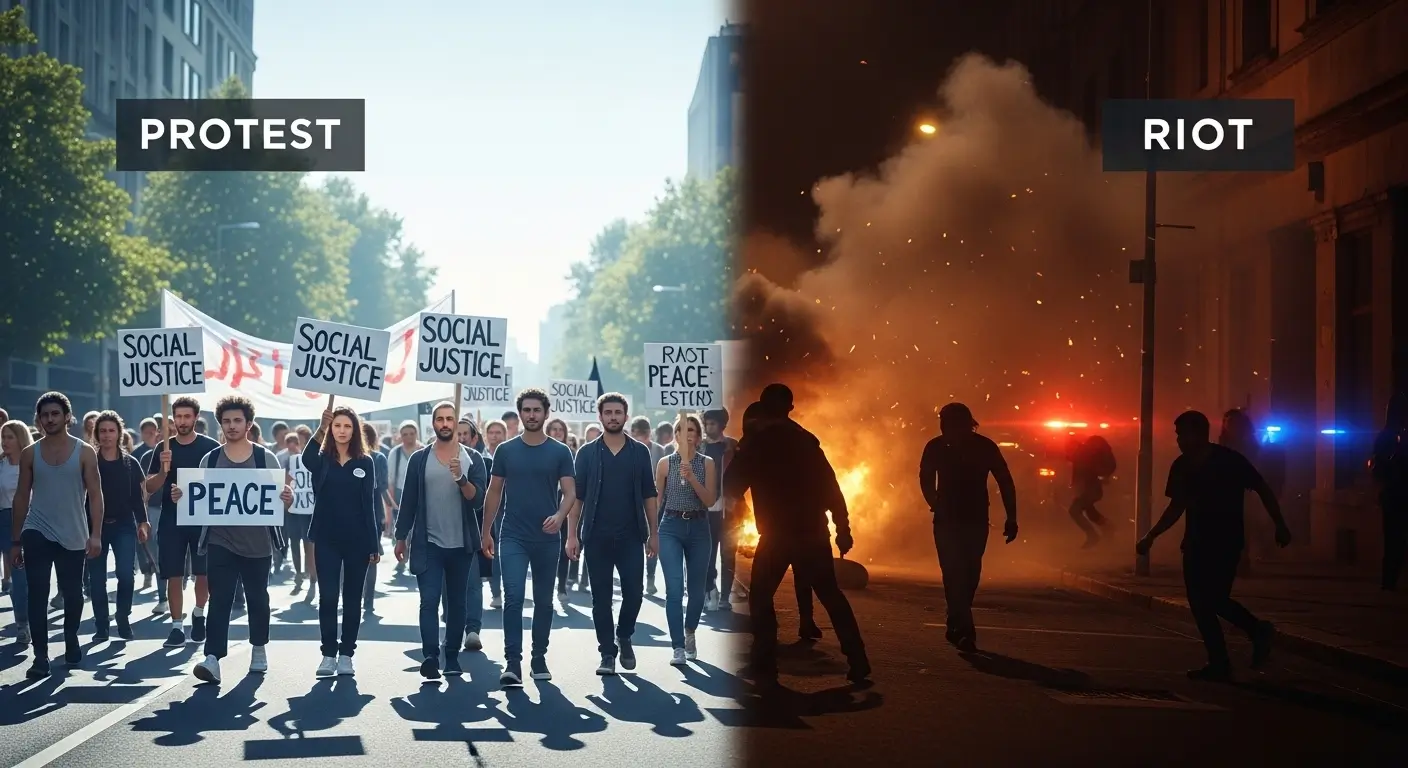
In 2020, millions of people gathered in cities across the world to raise their voices about social justice. Some groups marched peacefully, holding signs and chanting slogans—these were protests. In other places, however, violence broke out, shops were damaged, and clashes occurred with police—these incidents were called riots. This real-world example helps us understand the difference between riot and protest in a practical way.
The difference between riot and protest lies not only in actions but also in intention, organization, and public perception. While both involve groups expressing strong emotions or demands, the difference between riot and protest becomes clear when we observe the level of violence and the purpose behind the gathering. Understanding the difference between riot and protest is essential for students, journalists, and policymakers who analyze social movements and public behavior.
Key Difference Between the Both
A protest is usually a peaceful and organized public demonstration where people express disagreement or demand change. A riot, on the other hand, involves violent, chaotic behavior, often leading to property damage and public disorder.
Why Their Difference Is Necessary to Know
Understanding the difference between riot and protest is important because these terms are often used in news, politics, and social studies. Misusing them can change public opinion and even affect legal outcomes. For learners, it improves vocabulary precision and critical thinking. For experts—such as journalists, sociologists, and law professionals—using the correct term ensures accurate reporting and fair judgment. In society, this distinction helps protect the right to peaceful assembly while condemning unlawful violence.
Pronunciation of Both Words
| Word | US Pronunciation | UK Pronunciation |
| Riot | /ˈraɪ.ət/ | /ˈraɪ.ət/ |
| Protest | /ˈproʊ.test/ (noun), /prəˈtest/ (verb) | /ˈprəʊ.test/ (noun), /prəˈtest/ (verb) |
Linking Hook:
Now that we understand their basic meanings and importance, let’s explore the difference between riot and protest in detail through clear points, examples, and comparisons.
Difference Between Riot and Protest
1. Nature of Activity
Protest: Organized and peaceful.
Riot: Chaotic and violent.
Examples:
- People marching silently with placards is a protest.
- A crowd burning vehicles and breaking windows is a riot.
2. Purpose
Protest: To express opinions or demand change.
Riot: Often driven by anger, frustration, or sudden outrage.
Examples:
- Workers gathering to demand higher wages is a protest.
- Fans destroying property after a sports loss is a riot.
3. Level of Violence
Protest: Non-violent.
Riot: Includes physical aggression and damage.
Examples:
- Sit-ins and peaceful rallies are protests.
- Looting and stone-throwing during unrest are riots.
4. Organization
Protest: Usually planned and led by organizers.
Riot: Often spontaneous and unplanned.
Examples:
- A scheduled climate march is a protest.
- A crowd suddenly attacking shops after a rumor spreads is a riot.
5. Legal Status
Protest: Often protected by law as freedom of expression.
Riot: Considered illegal in most countries.
Examples:
- Authorities granting permission for a rally.
- Police arresting people involved in violent destruction.
6. Public Perception
Protest: Seen as a democratic right.
Riot: Viewed as a threat to public safety.
Examples:
- Peaceful demonstrators gaining public support.
- Rioters being criticized by media and society.
7. Participants’ Behavior
Protest: Disciplined and focused.
Riot: Aggressive and uncontrolled.
Examples:
- Protesters chanting slogans in unity.
- Rioters fighting among themselves and with police.
8. Outcome
Protest: Can lead to policy changes or dialogue.
Riot: Often leads to stricter laws and punishment.
Examples:
- Government negotiating after a peaceful demonstration.
- Authorities imposing curfew after riots.
9. Media Coverage
Protest: Highlighted for its message.
Riot: Highlighted for violence and destruction.
Examples:
- News showing speeches and banners.
- News focusing on burning buildings and clashes.
10. Emotional Tone
Protest: Determined but controlled.
Riot: Furious and explosive.
Examples:
- Students marching calmly for education reform.
- Crowds throwing stones in rage during riots.
Nature and Behaviour of Both
Protest
A protest reflects organized, purposeful, and disciplined behavior. Participants usually follow rules, cooperate with authorities, and aim to communicate a message clearly.
Riot
A riot reflects uncontrolled, emotional, and often destructive behavior. Individuals act impulsively, and group psychology amplifies aggression.
Why People Are Confused About Their Use
People often confuse riots and protests because both involve large crowds and public gatherings. Media headlines sometimes use the terms interchangeably, and events can start as protests but turn into riots, blurring the line between the two.
Difference and Similarity Table
| Feature | Protest | Riot | Similarity |
| Purpose | Express opinion | Release anger or chaos | Both involve public expression |
| Violence | Non-violent | Violent | Both involve large crowds |
| Planning | Organized | Often spontaneous | Both occur in public spaces |
| Legal Status | Usually legal | Illegal | Both may attract police presence |
| Public Reaction | Sympathy | Fear or criticism | Both gain media attention |
Which Is Better in What Situation?
A protest is better when people want to bring attention to an issue, demand rights, or influence policy. It allows individuals to express their views peacefully while maintaining social order. Peaceful demonstrations are more likely to gain public sympathy and government support.
A riot is never considered better, but it often occurs when people feel unheard or oppressed for a long time. While it may draw immediate attention, it usually harms the cause and leads to legal consequences. Therefore, protests are always the more constructive and effective choice.
Use in Metaphors and Similes
Both words are often used figuratively in English.
- “His thoughts were a riot of emotions” means chaotic and overwhelming feelings.
- “The classroom erupted like a protest against homework” compares students’ complaints to organized dissent.
Connotative Meaning
| Word | Connotation | Example |
| Riot | Mostly negative | “The city suffered heavy losses during the riot.” |
| Protest | Neutral to positive | “The peaceful protest inspired social change.” |
Idioms and Proverbs Related to the Words
- “A riot of colors” – meaning a vivid and lively mixture.
Example: The garden was a riot of colors in spring. - “Protest too much” – from Shakespeare, meaning someone denies something suspiciously.
Example: He kept saying he was innocent; he seemed to protest too much.
Works in Literature
- “The Day of the Locust” – Novel, Nathanael West, 1939 (depicts riot-like chaos in Hollywood)
- “Les Misérables” – Novel, Victor Hugo, 1862 (features student protests and uprisings)
Movies Based on These Themes
- “Detroit” – 2017, USA (depicts the 1967 Detroit riots)
- “The Trial of the Chicago 7” – 2020, USA (focuses on protests and political unrest)
Frequently Asked Questions
1. Can a protest turn into a riot?
Yes, a peaceful protest can become a riot if violence or chaos begins.
2. Are riots ever legal?
No, riots are generally considered illegal because they involve violence and public disorder.
3. Do all protests involve large crowds?
Not necessarily. Even small groups or individuals can stage a protest.
4. Why do riots start suddenly?
Riots often begin due to anger, rumors, or frustration that spreads quickly in a crowd.
5. How do authorities differentiate between them?
Authorities observe behavior, organization, and level of violence to classify an event.
How Both Are Useful for Surroundings
Protests help societies grow by allowing people to voice concerns and influence change peacefully. Riots, although destructive, sometimes highlight deep social issues that authorities can no longer ignore, forcing urgent attention.
Final Words for Both
Both riots and protests are expressions of public emotion and dissatisfaction. However, their methods and consequences differ greatly. One builds dialogue; the other creates destruction.
Conclusion
Understanding the difference between riot and protest helps us interpret news, analyze history, and use language accurately. While both involve groups reacting to social or political issues, their nature, intention, and outcomes are very different.
Protests reflect democratic values and organized communication, whereas riots reflect breakdowns in order and control. By recognizing these distinctions, individuals can better participate in civic life, report events responsibly, and contribute to peaceful social change.

Daniel Carter is a research writer and comparison specialist at Compadiff. He focuses on breaking down complex topics into simple explanations so readers can clearly understand the differences between similar concepts, products, and ideas.